
March 3, 2026 · By A1 Air Quality Consultants
Last updated: November 11, 2026
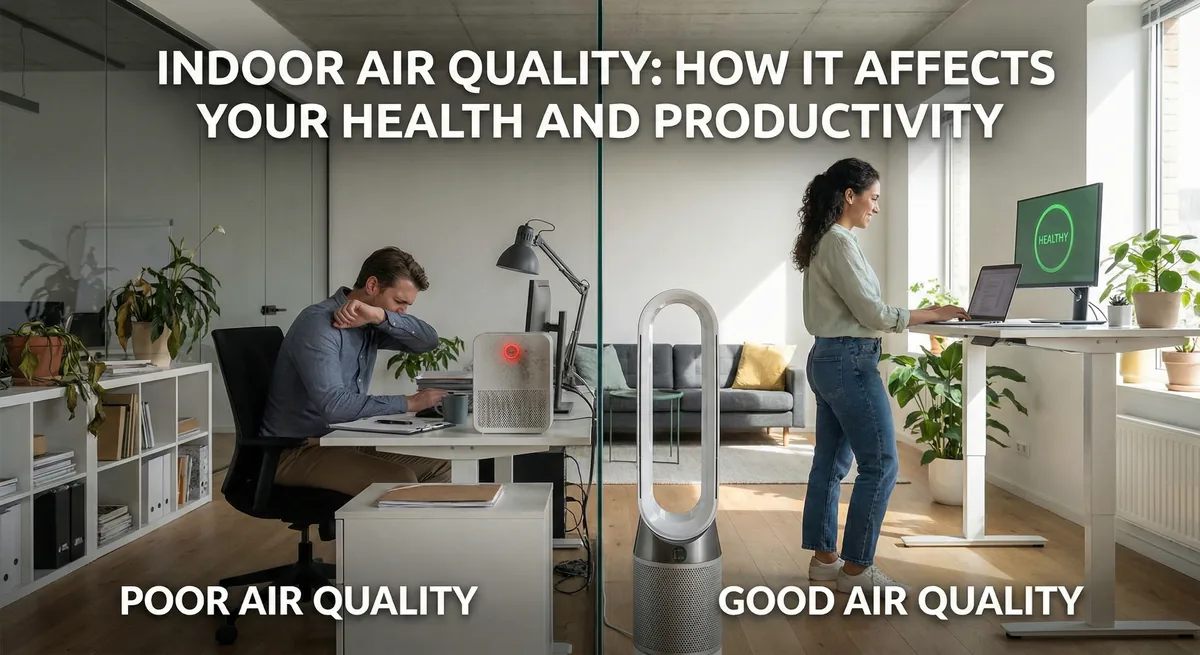
Indoor air quality can affect health and comfort, but a symptom or a single meter reading does not identify its cause. Different pollutants need different responses. Start with the building history, possible sources, ventilation, and moisture conditions; seek medical advice for persistent symptoms rather than relying on an environmental test to diagnose them.
Key Takeaway
Source control, suitable ventilation, and moisture management are practical starting points. Testing should answer a defined question; it cannot certify that every pollutant is absent or predict how an individual will feel.
Homes, offices, schools, and commercial buildings have different occupancy patterns and pollution sources. In humid weather, adding outdoor air also requires attention to moisture. An investigation should consider the actual property rather than assuming that every building needs the same sampling package.
How Does Poor Air Quality Affect Your Health?
The EPA explains that indoor pollutants can cause immediate or longer-term effects, while individual sensitivity, exposure level, and duration matter. Not every symptom is caused by indoor air.
Short-term health effects can include eye, nose, or throat irritation, headaches, dizziness, or fatigue. Similar symptoms have many other causes. Record where and when they occur and discuss persistent or worsening symptoms with a healthcare professional; improvement away from a building is a clue to investigate, not a diagnosis.
Long-term health effects depend on the pollutant and exposure. Some exposures are associated with respiratory disease, heart disease, or cancer. A general air-quality result does not establish a person's past exposure, medical condition, or future risk.
People with asthma or other existing conditions may need individualized precautions. A clinician can advise on symptoms and exposure concerns while a building professional investigates environmental conditions. These are complementary roles, not interchangeable tests.
What Are the Most Common Indoor Air Pollutants?
Indoor air contains a complex mixture of pollutants from multiple sources. Understanding what is in your air is essential to addressing the problem. Here are the most common indoor air pollutants and where they come from:
- Volatile Organic Compounds (VOCs): These are chemical gases emitted by a wide range of everyday products including paints, varnishes, cleaning supplies, air fresheners, new furniture, carpeting, building materials, and personal care products. The EPA has found that levels of many organic pollutants are consistently 2 to 5 times higher indoors than outdoors. Common VOCs include formaldehyde, benzene, toluene, and xylene. Learn more in our detailed guide to VOC testing and volatile organic compounds.
- Mold spores: Damp materials can support mold growth. Mold can cause irritation or allergic responses in some people, but color does not establish its health risk. Fix the moisture problem; see the signs you may need mold testing and NIOSH guidance on mold and testing limits.
- Particulate matter (PM2.5 and PM10): Cooking, smoke, candles, and outdoor sources can add airborne particles. Particle measurements do not identify every chemical or biological component, and a particle reading alone does not identify its source.
- Carbon dioxide (CO2): Occupants exhale CO2. Measurements can help investigate ventilation when occupancy, outdoor levels, timing, and sensor performance are considered. ASHRAE cautions that CO2 is not an overall indicator of indoor air quality; 1,000 ppm is not a universal pass/fail health threshold.
- Radon: This radioactive gas can enter from the ground and cannot be identified by smell or sight. Use a radon-specific measurement rather than assuming that a general air-quality panel includes it.
- Airborne Contaminants: Dust mites, pet dander, pollen, and other airborne particulates accumulate in indoor environments and trigger respiratory reactions and asthma in sensitive individuals.
- Carbon monoxide (CO): Faulty or improperly used fuel-burning equipment can produce this odorless, potentially deadly gas. If a CO alarm sounds or poisoning is suspected, get outside and call 911; do not wait for an inspection appointment. Follow CPSC emergency guidance and do not reenter until responders permit it.
How Does Air Quality Impact Workplace Productivity?
Research has examined links between indoor environmental conditions and performance on cognitive tasks. Those findings support investigating building conditions, but they do not supply a guaranteed productivity increase for a particular workplace.
A controlled office-exposure study published in Environmental Health Perspectives compared cognitive-test scores under different ventilation, VOC, and CO2 conditions. Results from a controlled study should not be presented as a promised percentage improvement in everyday job performance.
ASHRAE's 2025 position document describes the evidence for direct effects of CO2 at commonly observed indoor concentrations as inconsistent. CO2, other pollutants, temperature, and occupancy can vary together, so interpreting a workplace complaint requires more than one number.
For an actual building, record the complaint, affected rooms, occupancy, maintenance history, and operating conditions. Evaluate changes against that specific problem instead of applying a universal financial return or performance percentage.
For building owners and facility managers, professional air quality testing may support a defined investigation. Agree on what a measurement can answer before using it to select ventilation, filtration, or source-control work.
Worried about air quality at home or work? Call (864) 619-2092 or schedule a free consultation today.
Who Is Most Vulnerable to Poor Air Quality?
Sensitivity varies by pollutant and person. The following groups may need additional precautions or medical advice rather than a one-size-fits-all testing threshold:
- Children: Their developing bodies and activity patterns can affect exposure and response. Discuss ongoing symptoms or an existing respiratory condition with their healthcare professional.
- Older adults: Existing heart or lung conditions may affect how someone responds to an exposure.
- Pregnant people: Ask a healthcare professional about specific exposure concerns; a general air test is not a pregnancy risk assessment.
- People with asthma or allergies: Identified triggers and an existing care plan should guide personal precautions.
- People with weakened immune systems: Get medical advice before entering or cleaning a mold-damaged area.
How Can You Improve Your Air Quality?
The EPA describes three approaches: source control, ventilation, and air cleaning. Choose them for the actual pollutant and building conditions.
Source control means removing or reducing an identified source: address leaks, avoid indoor smoking, and follow product precautions. Do not disturb suspect asbestos, lead paint, or hidden mold as an informal air-quality experiment.
Ventilation improvements should account for outdoor smoke or pollution, humidity, weather, and building safety. Kitchen and bathroom exhaust should vent outdoors. Many residential heating and cooling systems recirculate air without supplying outdoor air; a qualified HVAC professional can review the system.
Air cleaning has limits. Particle filters do not remove all gases, and gas-removal media are not effective for every chemical. Select and maintain equipment for the intended pollutant; filtration does not repair a leak or eliminate a continuing source.
When Should You Get Professional Air Quality Testing?
Start with the concern and building history. Our guide to air quality testing explains how inspection and selected measurements fit together. Sampling is useful when it can answer a specific unresolved question.
Discuss an assessment, and whether targeted testing is useful, when:
- You or your family experience persistent health symptoms that improve when you leave the building
- You notice musty odors or visible mold
- Your home or building has experienced water damage or flooding
- You are in the middle of or have recently completed renovation projects
- You are moving into a new home or office
- You have vulnerable household members such as young children, elderly residents, or people with asthma
- Workplace occupants report a recurring concern in particular rooms or operating conditions
A sampling plan should name the target pollutant, locations, collection period, method, and interpretation limits. It cannot test for everything, diagnose illness, or guarantee safe occupancy. For visible mold, sampling is often unnecessary before addressing moisture and cleanup; an assessment is not a reason to postpone those actions.
A1 Air Quality Consultants can discuss the property concern and confirm the available assessment scope before booking. Ask which measurements are proposed, what the report will explain, and whether the question requires a different specialist.
Need professional testing? Contact A1 Air Quality Consultants or call (864) 619-2092 for a free consultation.