
November 19, 2025 · By A1 Air Quality Consultants
Last updated: November 11, 2026
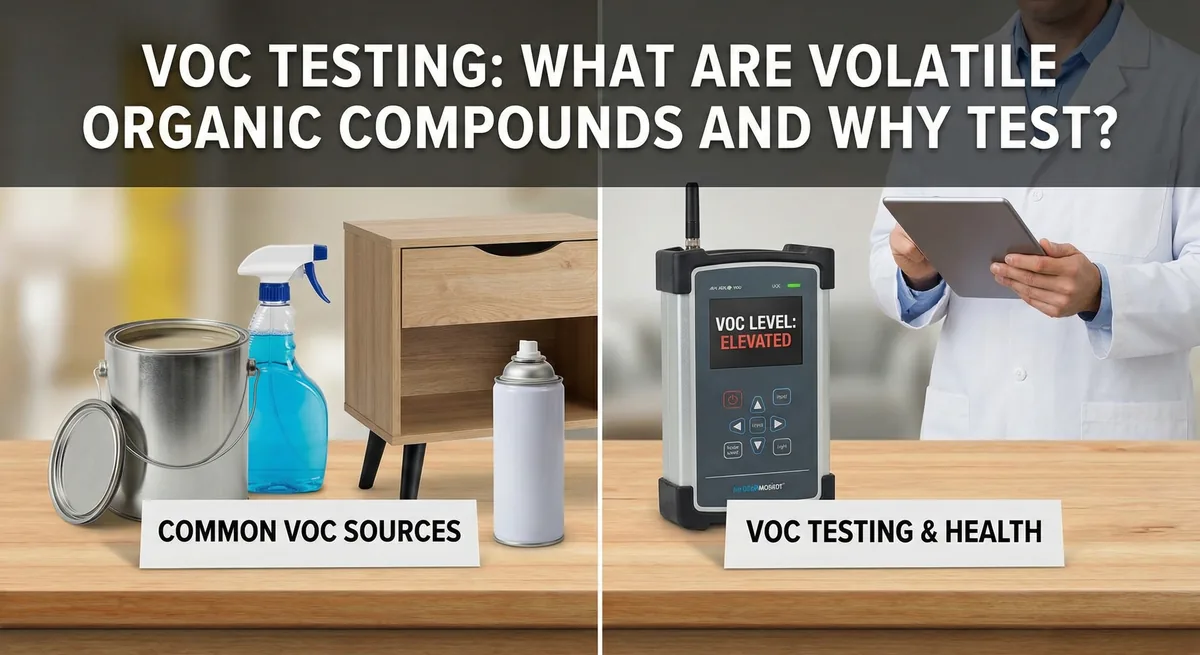
Volatile organic compounds (VOCs) are carbon-based chemicals that can enter indoor air from products, materials, and other sources. They do not all have the same health effects. Useful testing starts with a specific concern and a method suited to the compounds involved, rather than treating one total-VOC number as a complete assessment.
Key Takeaway
A VOC result needs a named method, target-compound list, sampling period, and interpretation limits. A broad screening number cannot identify every chemical, diagnose symptoms, or establish that a room is safe.
What Exactly Are Volatile Organic Compounds?
Volatile organic compounds can evaporate under ordinary indoor conditions. Odor is not a dependable measure of concentration or health risk: a noticeable smell does not identify the chemical, and the absence of an odor does not establish clean air.
The EPA explains that indoor-air and outdoor regulatory definitions differ. A product's VOC label is not a complete inventory of chemicals it may emit indoors.
Examples include formaldehyde, benzene, toluene, and xylene. Their sources, measurement methods, and relevant guidance differ. A general indoor air quality assessment should first establish which question a sample needs to answer.
What Are the Most Common Sources of VOCs in Homes and Buildings?
VOCs are released by a surprisingly wide range of everyday products and materials. Understanding these sources can help you minimize your exposure and determine whether testing is warranted.
Building materials and furnishings:
- Paints, stains, varnishes, and paint strippers
- Pressed wood products (plywood, particleboard, MDF) that contain formaldehyde-based adhesives
- New carpeting, carpet padding, and vinyl flooring
- Caulks, sealants, and adhesives
- Insulation materials, including spray foam
- Composite wood cabinetry and furniture
Household products:
- Cleaning and disinfecting products
- Air fresheners and scented candles
- Personal care products such as hair spray and perfume
- Dry-cleaned clothing
- Pesticides and moth repellents
- Stored fuels, solvents, and hobby supplies
Other sources:
- Tobacco smoke
- Printers and copiers in office settings
- Cooking and wood-burning stoves
- Attached garages where vehicles idle or chemicals are stored
In its VOC overview, EPA reports that its TEAM studies found about a dozen organic pollutants at higher average concentrations indoors than outdoors. This is not a prediction for every chemical or every home.
Keep a record of recent products, renovations, odors, and operating conditions. That history is more useful for planning a targeted investigation than assuming the same source exists in every building.
What Are the Health Effects of VOC Exposure?
Health effects vary greatly by compound, concentration, exposure duration, and individual. EPA notes uncertainty about effects at levels usually found in homes. The examples below are possible effects of some exposures, not a diagnosis based on a VOC reading.
Possible short-term effects of some exposures include:
- Eye, nose, and throat irritation
- Headaches and dizziness
- Nausea and vomiting
- Worsening of asthma symptoms
- Fatigue and difficulty concentrating
- Skin irritation and allergic reactions
Longer-term concerns depend on the chemical and exposure:
- Damage to the liver, kidneys, and central nervous system
- Increased cancer risk — benzene and formaldehyde are classified as known human carcinogens by the International Agency for Research on Cancer (IARC)
- Any chemical-specific concern needs an appropriate health reference, not a universal TVOC cutoff
- Environmental sampling cannot establish a person's medical condition or past exposure
Headaches, irritation, or fatigue can have causes unrelated to VOCs. Discuss persistent or worsening symptoms with a healthcare professional. Building history and testing can inform an environmental investigation, but do not identify a medical cause on their own. See our guide to indoor air quality, health, and productivity.
Have a recurring chemical odor or a product-related air-quality question? Call (864) 619-2092 or schedule a free consultation today.
What Are the EPA Guidelines for VOC Levels?
EPA states that there are no federally enforceable VOC standards for non-industrial settings. This does not mean every exposure is harmless, or that a single total-VOC value can classify a home as safe or unsafe.
Before interpreting a TVOC or individual-compound result, ask:
- What was measured? Identify the compounds or sensor response included in the result.
- Which method and units were used? Different instruments and methods may report different mixtures and values.
- What period does it represent? A short reading and a longer integrated sample answer different questions.
- What are the limitations? Review reporting limits, possible interferences, and compounds outside the scope.
- Which reference is appropriate? Any comparison needs the same chemical, exposure duration, and relevant population.
Workplace exposure limits are not blanket residential clearance criteria. A report should explain the basis for a comparison rather than applying occupational limits or generic TVOC bands to every household. A number below a chosen reference does not certify that all indoor hazards are absent.
How Is Professional VOC Testing Performed?
Indoor air quality testing may use different collection and analysis methods. The following are general examples, not a promise that a particular A1 visit includes every method. Confirm availability, target compounds, laboratory scope, and report contents before booking.
Canister sampling: Specially prepared canisters can collect air for a defined period and laboratory analysis. EPA's air-methods compendium includes canister methods with gas chromatography-mass spectrometry (GC-MS); the selected method and laboratory panel determine which compounds are reported.
Sorbent tube sampling: Selected chemicals are collected on a suitable sorbent for laboratory analysis. The tube, flow, sample volume, storage, and analytical method must suit the target compounds; no tube captures every VOC equally.
Real-time screening: A PID or consumer TVOC sensor may help track changes, but it does not identify each chemical or respond equally to all VOCs. PNNL explains why consumer TVOC readings require caution. Screening and compound-specific laboratory results are not interchangeable.
Formaldehyde-specific testing: Ask whether formaldehyde is included and which method will measure it. EPA notes that it may require a different method from chemicals such as benzene and toluene.
Commercial and industrial settings may need a separately defined occupational assessment. Do not assume a residential-style sample establishes workplace compliance or worker safety.
When Should You Get VOC Testing?
Discuss whether targeted sampling could answer a useful question in these situations:
- New construction or major renovation: Review the materials, product instructions, ventilation, and any specific concern before choosing a panel.
- After installing new flooring, cabinets, or furniture: Keep product information and installation dates so the investigation can focus on plausible sources.
- Unexplained health symptoms: Seek medical advice; an environmental investigation can run alongside care but cannot diagnose the cause.
- Strong or unusual odors: Persistent chemical smells that do not dissipate with normal ventilation.
- Real estate transactions: A home inspection and selected environmental tests have different scopes. A VOC panel is not a complete indoor-air safety check.
- Workplace complaints: Record locations, timing, activities, and operating conditions without assuming that VOCs caused the symptoms.
How Can You Reduce VOC Exposure in Your Home?
You do not need to wait for a test to follow product precautions or address an obvious source. Practical steps include:
- Use appropriate ventilation: Follow product directions and consider outdoor smoke, pollution, humidity, weather, and safety before opening windows.
- Read low-VOC claims carefully: Check what the label or emissions certification covers; it is not a guarantee that a product emits no relevant chemicals.
- Follow installation and use instructions: Ask the manufacturer about ventilation and occupancy precautions rather than relying on a universal off-gassing deadline.
- Store chemicals properly: Follow label requirements, keep them away from children and pets, and use local hazardous-waste disposal options for unwanted products.
- Maintain your HVAC system: Follow the manufacturer's filter and maintenance requirements; a typical particle filter does not remove VOC gases.
- Understand gas-filter limits: Suitable activated-carbon or other gas-removal media may reduce selected gases, but capacity and replacement matter. No air cleaner removes every pollutant.
- Avoid air fresheners and scented products: Many of these products simply add more VOCs to your indoor air rather than improving air quality
Reducing a source is generally preferable to relying on an air cleaner alone. Consult EPA guidance on air cleaners and filters before choosing equipment for a specific pollutant.
A1 Air Quality Consultants can discuss your concern and confirm the proposed VOC assessment scope, methods, and reporting limitations before scheduling. Ask who will perform collection and analysis and which qualifications apply to that scope.
Need professional testing? Contact A1 Air Quality Consultants or call (864) 619-2092 for a free consultation.