
March 4, 2026 · By A1 Air Quality Consultants
Last updated: March 4, 2026
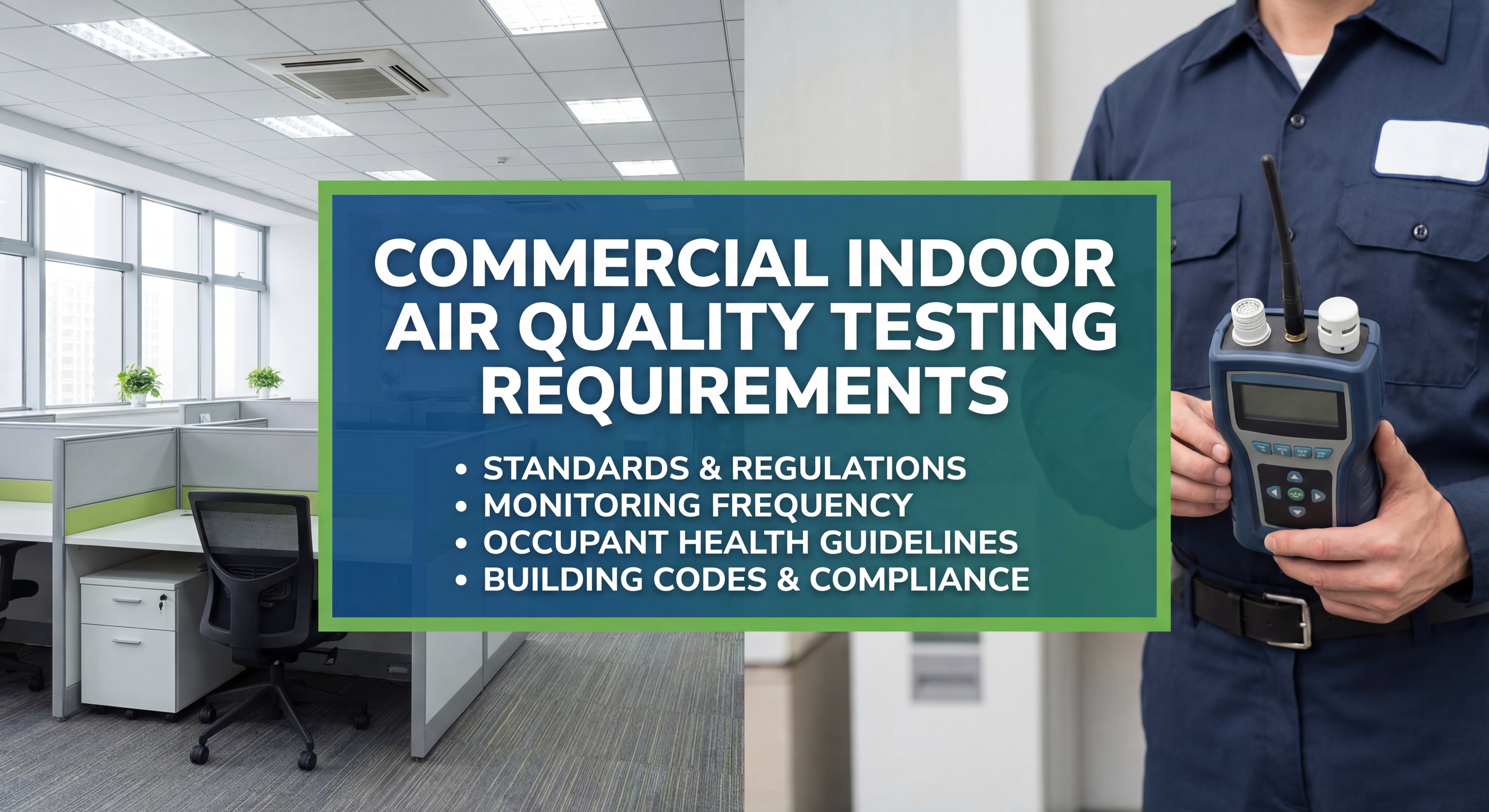
Commercial air quality testing ensures that office buildings, schools, healthcare facilities, and other commercial spaces meet OSHA and ASHRAE standards for occupant health and safety. Professional testing measures key parameters including carbon dioxide, carbon monoxide, volatile organic compounds, particulate matter, temperature, and humidity to identify ventilation problems, contamination sources, and conditions that affect occupant health and productivity.
Key Takeaway
Commercial buildings must maintain acceptable air quality under OSHA's General Duty Clause and are guided by ASHRAE Standard 62.1 for ventilation. Professional IAQ testing identifies problems such as inadequate ventilation, elevated CO2, VOC contamination, and conditions that contribute to sick building syndrome.
The indoor environment of commercial buildings directly affects the health, comfort, and productivity of everyone inside. According to the EPA, Americans spend approximately 90 percent of their time indoors, and for many working adults, a significant portion of that time is spent in commercial buildings. When the air quality in these spaces falls below acceptable levels, the consequences can range from minor discomfort to serious health problems and significant financial losses for building owners and employers.
Why Is Commercial Air Quality Testing Important?
Commercial air quality testing serves multiple critical purposes for building owners, employers, and facility managers:
- Occupant health: Poor air quality in commercial buildings can cause headaches, fatigue, respiratory irritation, eye and throat discomfort, dizziness, and difficulty concentrating. Long-term exposure to elevated pollutant levels has been linked to more serious conditions including respiratory disease and cardiovascular problems. Occupants in commercial buildings often cannot control their own environment the way they can at home, making employer responsibility even more important.
- Productivity: Research published by Harvard University's T.H. Chan School of Public Health found that improved air quality in office environments is associated with higher cognitive function scores. Studies have shown that poor IAQ can reduce worker productivity by up to 10 percent and increase absenteeism. For more details on this relationship, see our article on air quality, health, and productivity.
- Legal liability: Employers have a legal obligation under OSHA to provide a workplace free from recognized hazards. If employees become ill due to poor air quality and the employer failed to address known or foreseeable IAQ problems, the employer may face OSHA citations, workers' compensation claims, and civil liability.
- Property value and tenant retention: Commercial buildings with documented good air quality attract and retain tenants more effectively. IAQ testing and maintenance demonstrate a proactive approach to building management that tenants and prospective buyers value.
What Are OSHA Air Quality Standards?
The Occupational Safety and Health Administration (OSHA) does not have a single comprehensive air quality standard for non-industrial workplaces. However, several OSHA provisions apply directly to commercial IAQ:
- General Duty Clause (Section 5(a)(1)): This foundational OSHA requirement states that employers must provide a workplace free from recognized hazards that are causing or likely to cause death or serious physical harm. OSHA has used the General Duty Clause to cite employers for IAQ-related violations, including inadequate ventilation, carbon monoxide exposure, and mold contamination.
- Permissible Exposure Limits (PELs): OSHA sets PELs for hundreds of airborne contaminants, including carbon monoxide (50 ppm as an 8-hour time-weighted average), formaldehyde (0.75 ppm TWA), and many other chemicals. While PELs were primarily designed for industrial settings, they apply to all workplaces.
- Ventilation standards: OSHA's general industry standards (29 CFR 1910.94) address ventilation requirements, and OSHA frequently references ASHRAE Standard 62.1 as the recognized guideline for acceptable ventilation in commercial buildings.
It is important to note that meeting OSHA PELs alone does not guarantee acceptable air quality for office workers. OSHA PELs are based on healthy adult workers in industrial environments and do not account for the lower tolerances of office workers, visitors, or individuals with pre-existing health conditions. This is why ASHRAE standards, which set stricter guidelines for non-industrial settings, are the more relevant benchmark for most commercial buildings.
What Does ASHRAE Standard 62.1 Require?
ASHRAE Standard 62.1, titled "Ventilation for Acceptable Air Quality," is the most widely referenced standard for commercial building ventilation and IAQ. It provides two compliance pathways:
- Ventilation Rate Procedure: This prescriptive approach specifies minimum outdoor air ventilation rates based on occupancy type and density. For example, an office space requires a minimum of 5 cubic feet per minute (cfm) of outdoor air per person plus 0.06 cfm per square foot of floor area. These rates are designed to dilute indoor pollutants to acceptable levels.
- Air Quality Procedure: This performance-based approach allows building owners to demonstrate acceptable IAQ through direct measurement of indoor contaminants. Rather than prescribing specific ventilation rates, it requires that measured pollutant concentrations remain below established limits.
ASHRAE 62.1 also addresses CO2 monitoring as a proxy for ventilation adequacy. Indoor CO2 levels should generally not exceed 700 ppm above outdoor levels, which typically means keeping indoor CO2 below approximately 1,100 ppm. Levels above this threshold indicate insufficient outdoor air ventilation and are associated with occupant complaints about stuffy air, drowsiness, and difficulty concentrating.
What Does Commercial IAQ Testing Measure?
A comprehensive commercial air quality assessment measures multiple parameters to build a complete picture of the building's indoor environment. The most commonly tested parameters in commercial and industrial testing include:
- Carbon dioxide (CO2): The primary indicator of ventilation adequacy. Elevated CO2 levels indicate that the HVAC system is not providing sufficient outdoor air to the occupied space. Continuous CO2 monitoring during occupied hours reveals patterns that spot checks may miss.
- Carbon monoxide (CO): A dangerous byproduct of incomplete combustion from parking garages, loading docks, nearby traffic, and malfunctioning heating equipment. Even low levels can cause headaches and impaired cognitive function.
- Volatile organic compounds (VOCs): Chemical gases emitted by office furniture, carpet, paint, cleaning products, copiers, and printers. New construction and renovations often cause temporary spikes in VOC levels. For a detailed discussion, see our guide on VOC testing and volatile organic compounds.
- Particulate matter (PM2.5 and PM10): Fine particles from outdoor air infiltration, construction dust, deteriorating building materials, and indoor activities. Adequate filtration in the HVAC system is the primary control measure.
- Temperature: ASHRAE Standard 55 recommends thermal comfort ranges of 68 to 76 degrees Fahrenheit for typical office settings. Temperature complaints are among the most common building occupant grievances.
- Relative humidity: Maintained ideally between 30 and 60 percent. Low humidity causes dry skin, eye irritation, and increased susceptibility to respiratory infections. High humidity promotes mold growth and dust mite proliferation.
Depending on the building and the concerns, testing may also include mold spore sampling, airborne contaminant testing, formaldehyde measurement, and assessment of airborne bacteria.
Concerned about air quality in your commercial building? Call (864) 619-2092 or request a free consultation to discuss your building's needs.
When Should a Commercial Building Be Tested?
Commercial IAQ testing is recommended in a variety of situations, both reactive and proactive:
- Occupant complaints: When multiple building occupants report headaches, fatigue, respiratory irritation, or other symptoms that seem related to the building environment, IAQ testing is the first step in identifying the cause. These complaints should never be dismissed without investigation.
- After renovations or construction: Renovation activities release dust, VOCs from new materials, and potentially asbestos or lead from older building materials. Post-renovation IAQ testing confirms that the building is safe for reoccupancy.
- Routine maintenance: Proactive testing every one to three years helps identify developing problems before occupants are affected. This is especially important for buildings with aging HVAC systems, older construction, or high occupant density.
- Due diligence for transactions: Buyers, sellers, and lessees of commercial properties increasingly include IAQ assessments as part of due diligence. Documented testing protects all parties and can influence property valuation.
- Changes in building use or occupancy: Converting a retail space to an office, increasing occupant density, or changing HVAC operating schedules can all affect air quality. Testing after significant changes confirms that the building systems are adequate for the new conditions.
- Water damage events: Water intrusion from roof leaks, plumbing failures, or flooding can lead to mold growth and deterioration of building materials. Post-event IAQ testing should include mold assessment.
How Is Commercial Air Quality Testing Different from Residential?
While the fundamental principles of IAQ testing are the same regardless of building type, commercial testing differs from residential testing in several important ways:
- Scale and sampling strategy: Commercial buildings require more sampling locations to adequately characterize air quality across different zones, floors, and areas. A residential test might involve three to five samples, while a commercial assessment may require dozens of sampling points across multiple floors and zones.
- Regulatory framework: Commercial buildings operate under OSHA regulations and are guided by ASHRAE standards, neither of which apply to residential settings. Testing protocols and documentation requirements are more structured for commercial environments.
- HVAC complexity: Commercial HVAC systems are far more complex than residential systems, with multiple air handling units, variable air volume systems, economizers, and centralized controls. IAQ testing in commercial buildings must account for these systems and evaluate their performance.
- Occupancy patterns: Commercial buildings have different occupancy schedules and densities than homes. Testing is typically conducted during normal occupied hours to capture representative conditions, and CO2 levels are monitored throughout the workday to assess ventilation under actual load.
- Reporting and documentation: Commercial IAQ reports must be more detailed and formally structured because they may be used for regulatory compliance, legal purposes, or building management decisions. Reports typically reference specific OSHA PELs, ASHRAE guidelines, and EPA reference values.
A1 Air Quality Consultants provides commercial and industrial air quality testing using calibrated, professional-grade equipment and accredited laboratory analysis. With over 25 years of experience, we serve commercial clients across North Carolina, South Carolina, and Georgia with independent, science-based testing and clear, actionable reports.
Need commercial IAQ testing? Contact A1 Air Quality Consultants or call (864) 619-2092 for a free consultation.