
November 19, 2025 · By A1 Air Quality Consultants
Last updated: March 4, 2026
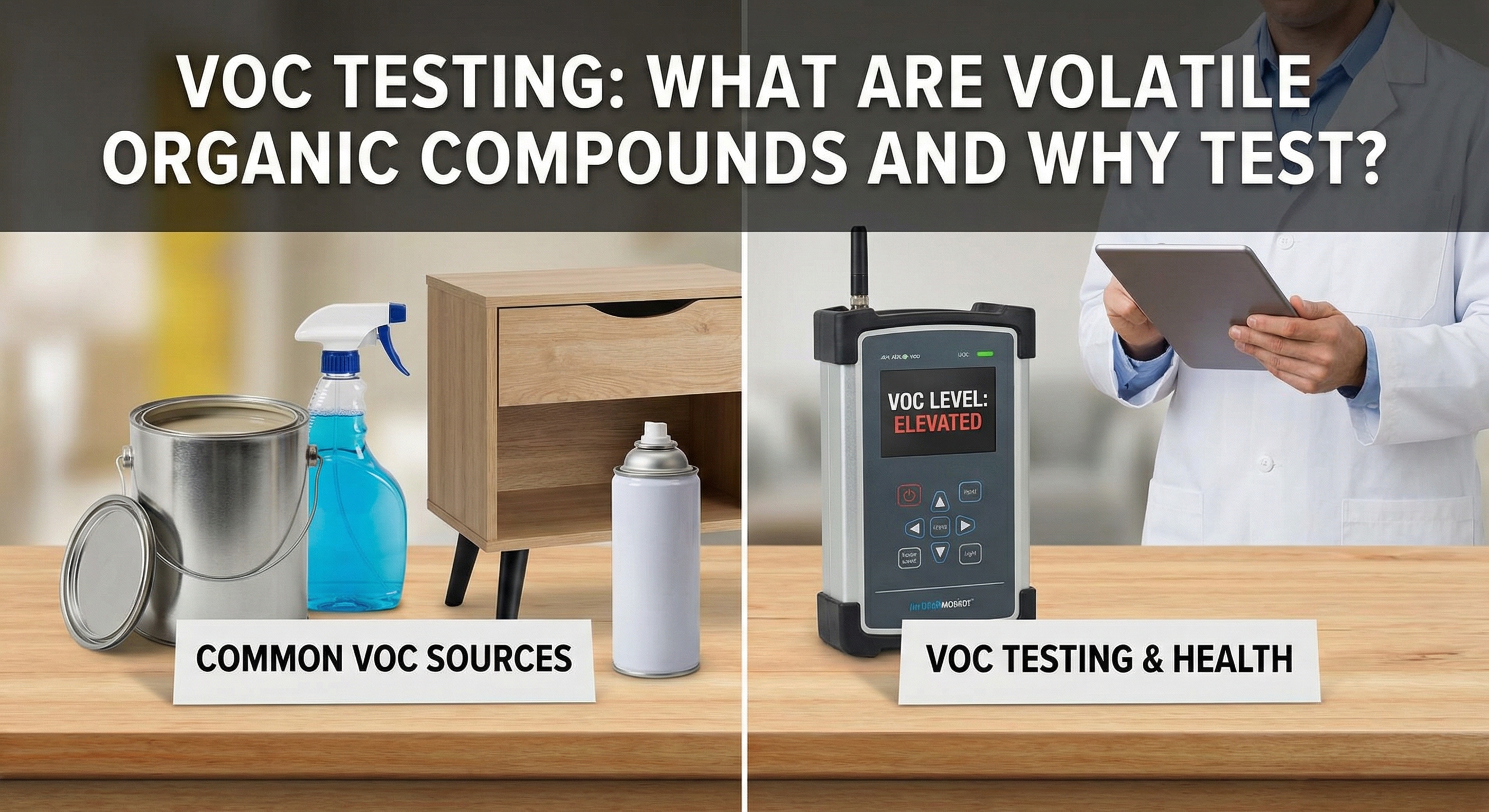
Volatile organic compounds (VOCs) are organic chemicals that evaporate at room temperature, releasing gases into your indoor air from common sources such as paints, cleaning products, building materials, and furnishings. According to the EPA, concentrations of many VOCs are consistently two to five times higher indoors than outdoors, and some activities like paint stripping can raise indoor levels up to 1,000 times above outdoor concentrations. VOC testing identifies and measures these invisible chemicals so you can take action to protect your family's health.
Key Takeaway
Volatile organic compounds (VOCs) are harmful chemicals released by paints, building materials, cleaning products, and furnishings that can cause headaches, respiratory irritation, and long-term health effects. Professional VOC testing identifies specific compounds and their concentrations so you can take targeted action to improve your indoor air quality.
What Exactly Are Volatile Organic Compounds?
Volatile organic compounds are a large group of carbon-based chemicals that easily evaporate (or "off-gas") at normal room temperatures. The word "volatile" refers to their tendency to become a gas, which is why you can often smell them — think of the strong odor of fresh paint, new carpet, or cleaning products. However, many harmful VOCs are odorless, making them impossible to detect without testing.
The EPA defines VOCs as organic compounds with a boiling point up to 250 degrees Celsius measured at standard atmospheric pressure. This broad definition includes hundreds of individual chemicals, some of which are harmless while others pose significant health risks even at low concentrations.
Common VOCs include formaldehyde, benzene, toluene, xylene, ethylene glycol, acetaldehyde, and perchloroethylene. Each has different sources, health effects, and acceptable exposure limits. Understanding which VOCs are present in your environment is the first step toward improving your indoor air quality.
What Are the Most Common Sources of VOCs in Homes and Buildings?
VOCs are released by a surprisingly wide range of everyday products and materials. Understanding these sources can help you minimize your exposure and determine whether testing is warranted.
Building materials and furnishings:
- Paints, stains, varnishes, and paint strippers
- Pressed wood products (plywood, particleboard, MDF) that contain formaldehyde-based adhesives
- New carpeting, carpet padding, and vinyl flooring
- Caulks, sealants, and adhesives
- Insulation materials, including spray foam
- Composite wood cabinetry and furniture
Household products:
- Cleaning and disinfecting products
- Air fresheners and scented candles
- Personal care products such as hair spray and perfume
- Dry-cleaned clothing
- Pesticides and moth repellents
- Stored fuels, solvents, and hobby supplies
Other sources:
- Tobacco smoke
- Printers and copiers in office settings
- Cooking and wood-burning stoves
- Attached garages where vehicles idle or chemicals are stored
The EPA notes that studies have found levels of about a dozen common organic pollutants to be two to five times higher inside homes than outside, regardless of whether the homes were located in rural or industrial areas. This is largely because of the concentration and quantity of VOC sources within enclosed living spaces.
In the warm, humid climate of the Southeast — including North Carolina, South Carolina, and Georgia — poor ventilation combined with high VOC-emitting materials creates indoor air quality challenges that many homeowners underestimate.
What Are the Health Effects of VOC Exposure?
VOC exposure can cause a wide range of health effects depending on the specific compounds involved, the concentration levels, and the duration of exposure. Health effects are generally categorized as short-term (acute) and long-term (chronic).
Short-term health effects include:
- Eye, nose, and throat irritation
- Headaches and dizziness
- Nausea and vomiting
- Worsening of asthma symptoms
- Fatigue and difficulty concentrating
- Skin irritation and allergic reactions
Long-term health effects include:
- Damage to the liver, kidneys, and central nervous system
- Increased cancer risk — benzene and formaldehyde are classified as known human carcinogens by the International Agency for Research on Cancer (IARC)
- Reproductive harm and developmental effects
- Chronic respiratory disease
The EPA warns that the risk of health effects from inhaling any chemical depends on how much is in the air, how long and how often a person breathes it in, and the person's sensitivity. Even low-level chronic exposure can contribute to a condition known as Sick Building Syndrome (SBS), where building occupants experience acute health and comfort effects that appear to be linked to time spent in a building. This is a growing concern in modern airtight buildings, and our article on indoor air quality, health, and productivity explores this topic further.
Noticing chemical odors or Sick Building Syndrome symptoms? Call (864) 619-2092 or schedule a free consultation today.
What Are the EPA Guidelines for VOC Levels?
Currently, the EPA does not have established regulatory standards for VOC levels in residential indoor environments. However, the agency provides guidelines and recommendations, and other organizations have established reference values.
General TVOC (total volatile organic compounds) guidelines suggest:
- Below 0.3 mg/m3: Good air quality — no expected health effects
- 0.3 to 0.5 mg/m3: Acceptable — unlikely to cause problems for most people
- 0.5 to 1.0 mg/m3: Marginal — may cause discomfort for sensitive individuals
- 1.0 to 3.0 mg/m3: Poor — likely to cause irritation and discomfort
- Above 3.0 mg/m3: Unhealthy — significant health effects expected
For individual compounds, OSHA sets workplace permissible exposure limits (PELs). For example, the OSHA PEL for formaldehyde is 0.75 ppm as an 8-hour time-weighted average. The EPA has established a reference concentration for chronic inhalation exposure to formaldehyde at 0.0098 mg/m3. NIOSH also publishes recommended exposure limits (RELs) for many individual VOCs that are often more protective than OSHA's enforceable PELs. These values help professionals interpret test results and recommend appropriate actions.
How Is Professional VOC Testing Performed?
Professional VOC testing uses several methods depending on the goals of the assessment and the types of compounds suspected. Indoor air quality testing professionals typically use one or more of the following approaches.
Summa canister sampling: Specially prepared stainless steel canisters collect whole-air samples over a specified period. These samples are then analyzed in an accredited laboratory using gas chromatography-mass spectrometry (GC-MS), which can identify and quantify hundreds of individual VOCs.
Sorbent tube sampling: Air is drawn through tubes containing adsorbent materials that capture VOCs. The tubes are then sent to a laboratory for thermal desorption and GC-MS analysis. This method is particularly effective for targeting specific compound groups.
Real-time photoionization detection (PID): Handheld PID instruments measure total VOC concentrations in real time, providing immediate screening results. While not as specific as laboratory analysis, PID testing can quickly identify areas with elevated VOC levels and guide further investigation.
Formaldehyde-specific testing: Because formaldehyde is one of the most common and concerning indoor VOCs, dedicated testing using DNPH cartridges or real-time monitors is often recommended as a standalone assessment.
Commercial and industrial settings may require additional testing protocols to comply with OSHA regulations and ensure worker safety.
When Should You Get VOC Testing?
Consider VOC testing in any of these situations:
- New construction or major renovation: New building materials are the largest source of VOC emissions. Testing before or shortly after occupancy can identify problems early.
- After installing new flooring, cabinets, or furniture: These products can release significant amounts of formaldehyde and other VOCs.
- Unexplained health symptoms: If occupants experience persistent headaches, eye irritation, respiratory issues, or fatigue that improves when they leave the building.
- Strong or unusual odors: Persistent chemical smells that do not dissipate with normal ventilation.
- Real estate transactions: Including VOC testing as part of a comprehensive home inspection provides a complete picture of indoor air quality.
- Workplace complaints: Multiple employees reporting similar symptoms can indicate Sick Building Syndrome related to VOC exposure.
How Can You Reduce VOC Exposure in Your Home?
While testing identifies the problem, there are several practical steps you can take to reduce VOC levels in your home:
- Increase ventilation: Open windows and use exhaust fans, especially when using VOC-emitting products or after bringing new materials into the home
- Choose low-VOC or zero-VOC products: Look for paints, adhesives, and building materials that are certified low-emission by programs like GREENGUARD or the California Section 01350 standard
- Allow new products to off-gas: When possible, unpackage new furniture or materials in a well-ventilated space or outdoors before bringing them into living areas
- Store chemicals properly: Keep paints, solvents, and cleaning products in a detached garage or shed rather than inside the home
- Maintain your HVAC system: Regular filter changes and proper maintenance help your system filter and circulate air effectively
- Use air purifiers with activated carbon filters: These can help reduce VOC concentrations in specific rooms
- Avoid air fresheners and scented products: Many of these products simply add more VOCs to your indoor air rather than improving air quality
The EPA recommends that source control — eliminating or reducing the source of VOCs — is the most effective strategy for reducing exposure. Ventilation improvements are the second most effective approach, and air cleaning is typically a supplemental measure rather than a standalone solution.
With over 25 years of experience and SCDES licensing, A1 Air Quality Consultants provides independent, science-based VOC testing you can trust.
Need professional testing? Contact A1 Air Quality Consultants or call (864) 619-2092 for a free consultation.