
August 20, 2025 · By A1 Air Quality Consultants
Last updated: March 4, 2026
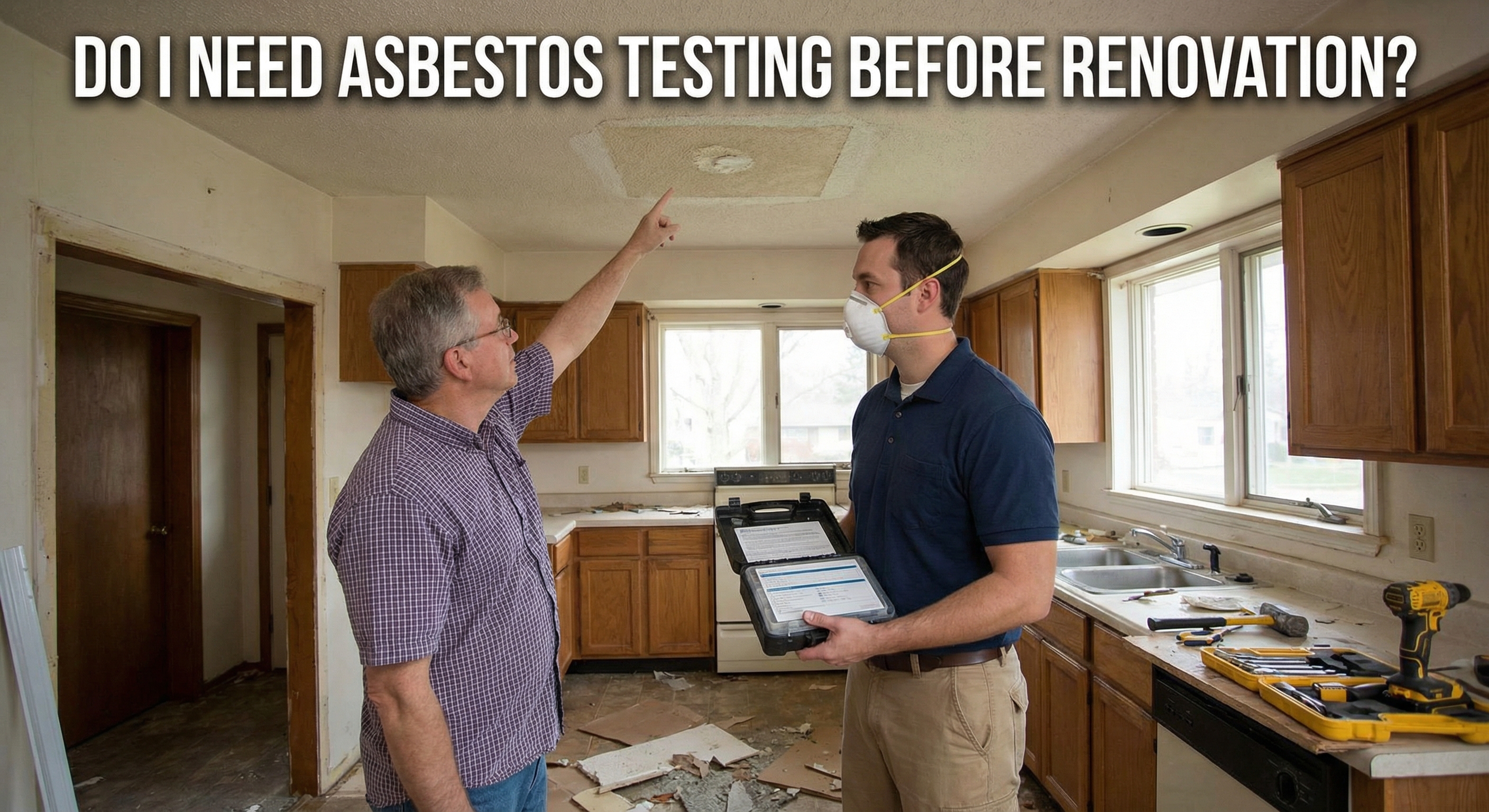
Yes, asbestos testing is legally required before renovation and demolition projects in many states, and it is strongly recommended for any building constructed before 1980. Under the EPA's National Emission Standards for Hazardous Air Pollutants (NESHAP), commercial and public buildings must be inspected for asbestos before renovation or demolition work begins. In South Carolina, SCDES enforces additional regulations that apply to both commercial and residential projects. Even where residential testing is not explicitly mandated by law, disturbing asbestos-containing materials without knowing they are present exposes workers and occupants to serious health risks and can result in significant legal and financial liability.
Key Takeaway
Yes — asbestos testing is strongly recommended and often legally required before renovating or demolishing buildings constructed before the 1980s. Disturbing asbestos-containing materials releases microscopic fibers that cause mesothelioma, lung cancer, and asbestosis.
Asbestos was used extensively in building materials from the 1920s through the late 1970s. The EPA estimates that asbestos can be found in approximately 733,000 public and commercial buildings in the United States. Residential use was equally widespread. If your home or building was constructed before 1980 and you are planning any renovation work — from a simple kitchen remodel to a major structural project — professional asbestos testing should be your first step.
What Are the Legal Requirements for Asbestos Testing Before Renovation?
The regulatory framework for asbestos testing involves federal, state, and sometimes local requirements. Understanding these regulations is essential for anyone planning a renovation or demolition project.
Federal NESHAP regulations: The EPA's NESHAP rules under the Clean Air Act require that all commercial and public buildings be inspected for asbestos by an accredited inspector before any renovation or demolition that could disturb more than a specified threshold of regulated asbestos-containing material. Violations can result in fines up to $37,500 per day per violation.
South Carolina SCDES regulations: In South Carolina, SCDES's Bureau of Air Quality administers the state asbestos program. SCDES requires notification before demolition or renovation of facilities that contain asbestos. Inspections must be performed by SCDES-licensed asbestos inspectors. The state also regulates asbestos abatement contractor licensing and worker certification.
North Carolina and Georgia: Both North Carolina (through the NC Department of Health and Human Services) and Georgia (through the Georgia Environmental Protection Division) have asbestos programs that mirror or expand upon federal NESHAP requirements. Commercial and institutional building owners must have asbestos surveys conducted before renovation.
Residential considerations: While NESHAP primarily targets commercial and public buildings, many states and municipalities require or strongly recommend asbestos testing for residential properties as well. Additionally, most reputable renovation contractors will not begin work on a pre-1980 home without seeing a clear asbestos inspection report. Homeowners who skip testing face health risks, potential liability if they later sell the property, and the possibility of contaminating their home if asbestos is unknowingly disturbed.
Where Is Asbestos Most Commonly Found in Buildings?
Asbestos was valued for its fire resistance, durability, and insulating properties, which led to its use in an astonishing variety of building products. During a pre-renovation inspection, a trained inspector will evaluate materials throughout the building, with particular attention to these common locations:
- Floor tiles and tile adhesive (mastic): 9-inch by 9-inch vinyl floor tiles manufactured before the 1980s are one of the most common asbestos-containing materials. The black adhesive used to secure them frequently contains asbestos as well.
- Popcorn and textured ceilings: Spray-on textured ceiling coatings applied before the mid-1980s very commonly contained asbestos fibers. Scraping or sanding these ceilings without testing releases fibers into the air.
- Pipe and duct insulation: Asbestos-containing insulation was widely used to wrap pipes, boilers, and HVAC ductwork, and is often found in basements, mechanical rooms, and crawl spaces.
- Vermiculite attic insulation: Much of the vermiculite insulation sold in the U.S. came from a mine in Libby, Montana, which was contaminated with asbestos. The EPA recommends treating all vermiculite insulation as potentially contaminated unless tested.
Asbestos was also commonly used in roofing shingles, cement siding, joint compound, and window glazing. For a comprehensive guide to asbestos types and where they hide in buildings, see our article on what asbestos is and why testing matters.
What Are the Health Risks of Asbestos Exposure?
The health risks of asbestos exposure are well documented and severe. When asbestos-containing materials are disturbed — through cutting, drilling, sanding, demolition, or even simple deterioration — microscopic fibers are released into the air. These fibers are so small they are invisible and can remain airborne for hours. Once inhaled, they become permanently lodged in lung tissue.
According to the CDC and the Agency for Toxic Substances and Disease Registry (ATSDR), asbestos exposure can cause:
- Mesothelioma: A rare and aggressive cancer of the lining of the lungs, abdomen, or heart. Mesothelioma is almost exclusively caused by asbestos exposure and has a median survival time of approximately 12 to 21 months after diagnosis.
- Lung cancer: Asbestos exposure significantly increases the risk of lung cancer, especially in combination with smoking. The EPA classifies asbestos as a known human carcinogen.
- Asbestosis: A chronic lung disease caused by the scarring of lung tissue from inhaled asbestos fibers. Asbestosis causes progressive shortness of breath, coughing, and permanent lung damage.
- Pleural thickening and plaques: Asbestos can cause thickening and calcification of the lining around the lungs, which can restrict breathing and cause chest pain.
The latency period for asbestos-related diseases is typically 10 to 50 years, meaning health effects may not appear until decades after exposure. There is no known safe level of asbestos exposure. Even brief, one-time exposure during a renovation project can pose a risk, which is why testing before disturbing any suspect material is so critical.
Planning a renovation? Get asbestos testing first. Call (864) 619-2092 or schedule a free consultation today.
What Does the Asbestos Testing Process Involve?
Professional asbestos testing follows a systematic process designed to identify all asbestos-containing materials that could be affected by your renovation project. Here is what to expect:
Pre-inspection planning: The inspector reviews your renovation plans to understand which materials will be disturbed. This focuses the inspection on the specific areas and materials relevant to your project.
Visual inspection: The inspector conducts a thorough visual assessment of the property, identifying all suspect materials based on age, appearance, manufacturer, and location. Experienced inspectors can often narrow down which materials are most likely to contain asbestos, but visual identification alone cannot confirm or rule out asbestos.
Bulk sample collection: Small samples of suspect materials are carefully collected using techniques that minimize fiber release. Each sample is labeled, documented, and placed in a sealed container. The number of samples required depends on the type and quantity of material present. NESHAP specifies minimum sampling requirements based on material area.
Laboratory analysis: Samples are sent to an accredited laboratory for analysis using polarized light microscopy (PLM) or transmission electron microscopy (TEM). PLM is the standard method for bulk samples and can detect asbestos content as low as 1 percent. Materials containing more than 1 percent asbestos are classified as asbestos-containing material (ACM) under EPA regulations.
Report and recommendations: The inspector provides a detailed report identifying which materials tested positive, the type and percentage of asbestos found, the condition of the materials, and recommendations for how to proceed with your renovation project.
What Happens If Asbestos Is Found Before Your Renovation?
Finding asbestos in your building does not necessarily mean your renovation project must stop or that costs will become prohibitive. The appropriate response depends on the type of material, its condition, and whether your renovation plans will disturb it.
Leave in place (management in place): Asbestos-containing materials that are in good condition and will not be disturbed by your renovation can often be safely left in place. An asbestos management plan documents the location and condition of these materials for future reference.
Encapsulation: Some materials can be treated with sealants that bind the asbestos fibers and prevent them from becoming airborne. This is often used for pipe insulation and textured ceilings that are in reasonable condition.
Enclosure: Building new materials over asbestos-containing surfaces — such as installing new flooring over asbestos floor tiles — can be a cost-effective alternative to removal in some situations.
Professional abatement: When asbestos-containing materials must be removed, licensed abatement contractors perform the work using strict containment, negative air pressure, HEPA filtration, and personal protective equipment. For commercial and industrial projects, abatement must follow all federal and state regulations, and air monitoring is typically required during and after the work.
Getting a clear asbestos assessment before starting your project allows you to plan for these scenarios, get accurate cost estimates, and avoid the far more expensive prospect of discovering asbestos mid-renovation — which can halt your project, require emergency abatement, and expose workers and occupants to dangerous fibers.
How Much Does Asbestos Testing Cost Compared to the Risks?
The cost of professional asbestos testing is a small fraction of the potential costs associated with unknowingly disturbing asbestos during renovation. A typical residential asbestos inspection with multiple bulk samples is among the most affordable pre-renovation expenses you will encounter.
Consider the alternative costs: emergency asbestos abatement after an unplanned discovery can cost thousands of dollars or more. Project delays while waiting for emergency abatement can add additional expense. EPA fines for NESHAP violations can reach $37,500 per day. Medical monitoring and potential health costs for exposed workers and occupants are incalculable. Legal liability if you sell a property with undisclosed asbestos contamination can be substantial.
The home inspection process should always include asbestos awareness, as we discuss in our home inspection checklist for mold, asbestos, lead, and radon. Additionally, properties built before 1978 may also contain lead-based paint, which presents its own set of renovation hazards. Learn more in our article on lead paint dangers in pre-1978 homes, and see our guide to lead paint testing for homeowners for details on testing methods and what to expect.
With over 25 years of experience and SCDES/AHERA certifications, A1 Air Quality Consultants delivers independent, science-based results you can trust. Testing before you start is always the smart, safe, and cost-effective approach.
Need professional testing? Contact A1 Air Quality Consultants or call (864) 619-2092 for a free consultation.