
January 22, 2026 · By A1 Air Quality Consultants
Last updated: March 4, 2026
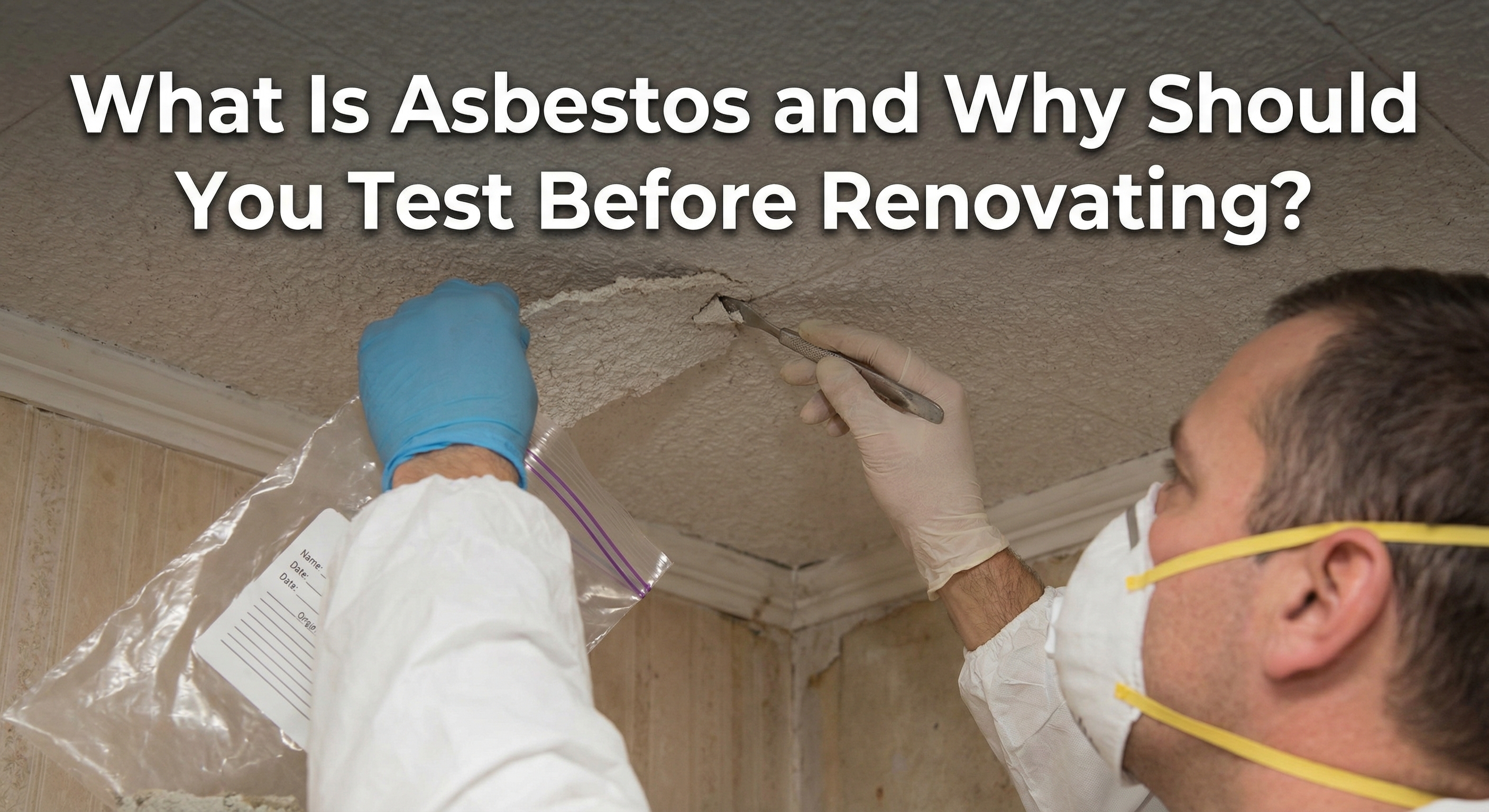
Asbestos is a group of naturally occurring mineral fibers that were widely used in construction materials before the 1980s due to their heat resistance and durability. When disturbed during renovation, these fibers become airborne and can cause serious lung disease, mesothelioma, and other cancers. The EPA estimates that asbestos is still present in approximately 733,000 public and commercial buildings and millions of residential homes across the United States. Because asbestos-containing materials cannot be identified by appearance alone, laboratory testing is the only way to confirm their presence before any renovation or demolition work begins.
Key Takeaway
Asbestos is a group of naturally occurring mineral fibers widely used in construction before the 1980s. When disturbed during renovation or demolition, asbestos fibers become airborne and can cause mesothelioma, lung cancer, and asbestosis — making professional testing essential before any remodeling project.
According to the CDC, asbestos exposure is responsible for approximately 39,000 deaths per year in the United States, including deaths from mesothelioma, asbestosis, and asbestos-related lung cancer. The danger is not from asbestos that is intact and undisturbed, but from fibers released when materials are cut, drilled, sanded, broken, or otherwise disrupted during renovation and demolition activities. Understanding what asbestos is, where it may be in your building, and why testing is required can protect your health, your family, and your legal compliance.
What Exactly Is Asbestos?
Asbestos refers to six naturally occurring silicate mineral fibers that are divided into two groups: serpentine and amphibole. Chrysotile, the only serpentine variety, accounts for approximately 90 to 95 percent of all asbestos used commercially worldwide. The amphibole group includes amosite, crocidolite, tremolite, actinolite, and anthophyllite, each with distinct fiber characteristics but all sharing the same fundamental health risks.
These minerals were prized in construction because of their remarkable physical properties. Asbestos fibers are heat resistant to temperatures exceeding 1,000 degrees Fahrenheit, chemically inert, electrically nonconductive, and extremely strong for their weight. They can be woven into fabric, mixed into cement, sprayed as insulation, and combined with dozens of other materials. These properties made asbestos ubiquitous in building materials from the 1920s through the late 1970s, and it was not banned in most applications in the United States until the EPA issued regulations in the 1970s and 1980s.
Where Is Asbestos Found in Buildings?
In buildings constructed before 1980, asbestos may be present in a wide range of materials. Knowing where to look is essential for any renovation project, but it is important to understand that asbestos cannot be confirmed or ruled out visually. Only professional asbestos testing with laboratory analysis can determine whether a material contains asbestos fibers. The most common locations include:
- Popcorn ceilings and textured coatings: Sprayed-on acoustic ceiling texture applied before 1980 frequently contains chrysotile asbestos, sometimes at concentrations of 1 to 10 percent.
- Vinyl floor tiles and sheet flooring: Nine-inch by nine-inch floor tiles manufactured before 1980 are particularly suspect, as are the black mastic adhesives used to install them and some sheet vinyl backing materials.
- Pipe insulation and boiler wrapping: Thermal insulation on heating pipes, boilers, and ducts in older buildings commonly contains asbestos. This material is often friable, meaning it crumbles easily and releases fibers when disturbed.
- Roof shingles and siding: Cement-asbestos roofing and siding shingles were widely used on residential and commercial buildings. These materials are durable but can release fibers when cut, drilled, or broken during removal.
- Joint compound and drywall mud: Drywall taping compounds manufactured before the mid-1970s often contained asbestos. Sanding these materials during renovation generates significant airborne fiber exposure.
- Insulation materials: Vermiculite attic insulation, particularly from the Libby, Montana mine (sold under the brand name Zonolite), may be contaminated with asbestos. Blown-in and batt insulation in walls and attics may also contain asbestos fibers.
- Cement board and transite panels: Flat and corrugated cement-asbestos panels were used for siding, roofing, and industrial applications. These rigid materials can release fibers when cut or drilled with power tools.
- Plaster, stucco, and putty: Some plaster and stucco formulations, particularly those designed for fire resistance, contained asbestos fibers as a reinforcing agent.
What Are the Health Risks of Asbestos Exposure?
Asbestos fibers are microscopic, with individual fibrils measuring as small as 0.1 microns in diameter, roughly 700 times thinner than a human hair. When inhaled, these fibers penetrate deep into the lungs and become permanently lodged in lung tissue. The body cannot break down or expel asbestos fibers, and over time they cause chronic inflammation, scarring, and cellular damage that can lead to several serious diseases.
Asbestosis is a progressive, non-cancerous scarring of lung tissue caused by inhaling asbestos fibers. It leads to shortness of breath, persistent cough, and reduced lung function that worsens over time. There is no cure for asbestosis.
Lung cancer caused by asbestos exposure is clinically identical to lung cancer caused by smoking, and the risk is multiplicative. According to the EPA, asbestos workers who smoke are 50 to 90 times more likely to develop lung cancer than the general population.
Mesothelioma is a rare and aggressive cancer that develops in the thin lining surrounding the lungs, abdomen, or heart. It is almost exclusively caused by asbestos exposure, with a latency period of 20 to 50 years between exposure and diagnosis. The CDC reports approximately 2,500 new cases of mesothelioma are diagnosed in the United States each year.
Need asbestos testing before a renovation? Call (864) 619-2092 or schedule a free consultation today.
What Do NESHAP and OSHA Regulations Require?
The federal regulatory framework for asbestos involves multiple agencies, each addressing different aspects of exposure prevention and management. Understanding these requirements is essential for anyone planning renovation or demolition work.
The EPA's National Emission Standards for Hazardous Air Pollutants (NESHAP) for asbestos requires that all commercial, public, and institutional buildings be inspected for asbestos-containing materials before renovation or demolition. If asbestos is found, it must be properly removed by licensed abatement contractors before any work that would disturb it. NESHAP applies to all facilities except residential buildings with four or fewer dwelling units.
OSHA's asbestos standards (29 CFR 1926.1101 for construction and 29 CFR 1910.1001 for general industry) establish permissible exposure limits, require employer-provided medical surveillance, mandate the use of specific work practices and personal protective equipment, and set training requirements for workers who may encounter asbestos on the job.
What Are South Carolina SCDES Asbestos Regulations?
In South Carolina, the Department of Environmental Services (SCDES) enforces federal NESHAP regulations and has additional state-level requirements. SCDES requires notification before any demolition or renovation project involving asbestos-containing materials in commercial buildings. Asbestos inspections must be conducted by SCDES-licensed asbestos inspectors, and abatement work must be performed by SCDES-licensed asbestos contractors.
For residential properties, while NESHAP does not technically apply to single-family homes, SCDES strongly recommends asbestos testing before any renovation that will disturb suspected materials. Contractors performing renovation work have a duty of care to their workers and occupants, and many will require asbestos testing before beginning work on older homes. Failure to properly manage asbestos during renovation can result in contamination of the living space, liability for cleanup costs, and potential health consequences for everyone involved. For a comprehensive pre-renovation checklist, see our home inspection checklist for mold, asbestos, lead, and radon.
How Is Asbestos Testing Performed?
Professional asbestos testing involves collecting physical samples of suspect materials and submitting them to an accredited laboratory for analysis. There are three primary analytical methods used to detect and quantify asbestos in building materials and air:
Polarized Light Microscopy (PLM) is the standard method for analyzing bulk building material samples. A trained microscopist examines the sample under polarized light to identify asbestos fiber types and estimate their concentration. PLM can detect asbestos at concentrations as low as 1 percent and is the most commonly used method for pre-renovation surveys. EPA Method 600/R-93/116 governs this analysis.
Phase Contrast Microscopy (PCM) is used to measure total airborne fiber concentrations during and after abatement work. PCM counts all fibers meeting specific size criteria but cannot distinguish asbestos from other fiber types. It is used as a screening tool and for OSHA compliance monitoring during abatement projects.
Transmission Electron Microscopy (TEM) provides the highest level of analysis, capable of identifying individual asbestos fibers at the molecular level and distinguishing them from non-asbestos fibers. TEM is used for final air clearance testing after abatement to verify that fiber levels are below the EPA clearance standard of 70 structures per square millimeter. This method is required for school buildings under AHERA and is recommended for high-stakes clearance situations.
During a typical commercial or residential inspection, a licensed inspector collects bulk samples from each homogeneous area of suspect material. Samples are carefully collected to minimize fiber release and are sealed in labeled containers for chain-of-custody documentation. Laboratory results are typically available within one to three business days, with rush turnaround available when needed.
What Should You Do If Asbestos Is Found?
If laboratory analysis confirms the presence of asbestos in materials that will be disturbed during your renovation project, you have several options depending on the condition of the material, the scope of the renovation, and the applicable regulations.
Abatement (removal): Complete removal of asbestos-containing materials by a licensed abatement contractor is the most definitive solution. This involves containment of the work area, use of HEPA-filtered negative air machines, wet removal techniques, proper waste packaging and disposal, and final clearance air testing to verify the area is safe for reoccupancy.
Encapsulation: In some cases, asbestos-containing materials can be treated with a sealant that binds the fibers and prevents their release. This approach is typically used for materials in good condition that will not be directly disturbed by renovation work.
Enclosure: Building an airtight barrier around asbestos-containing materials can be appropriate when removal is not necessary and the materials will remain undisturbed. This is common for pipe insulation in areas not affected by renovation.
Regardless of the approach, the critical first step is always testing. Without laboratory confirmation, you cannot make informed decisions about how to proceed safely and legally.
Why Does Independent Asbestos Testing Matter?
When choosing an asbestos testing provider, independence is essential. Companies that offer both testing and abatement services have a direct financial incentive to find asbestos and recommend expensive removal. An independent testing company like A1 Air Quality Consultants has no stake in the outcome. We do not perform remediation or removal, so our results are always objective and our recommendations are always honest.
We are SCDES & NCDHHS licensed and serve homes and businesses across North Carolina, South Carolina, and Georgia. Our inspectors are trained and accredited, and every sample is analyzed by an accredited laboratory. Whether you are planning a kitchen renovation, a commercial build-out, or a complete demolition, we provide the accurate data you need to move forward safely and in compliance with all applicable regulations. Learn more about the value of independent testing in our article on why independent testing matters. For additional pre-renovation guidance, see our guide on whether you need asbestos testing before renovation.
Need professional testing? Contact A1 Air Quality Consultants or call (864) 619-2092 for a free consultation.