March 4, 2026 · By A1 Air Quality Consultants
Last updated: March 4, 2026
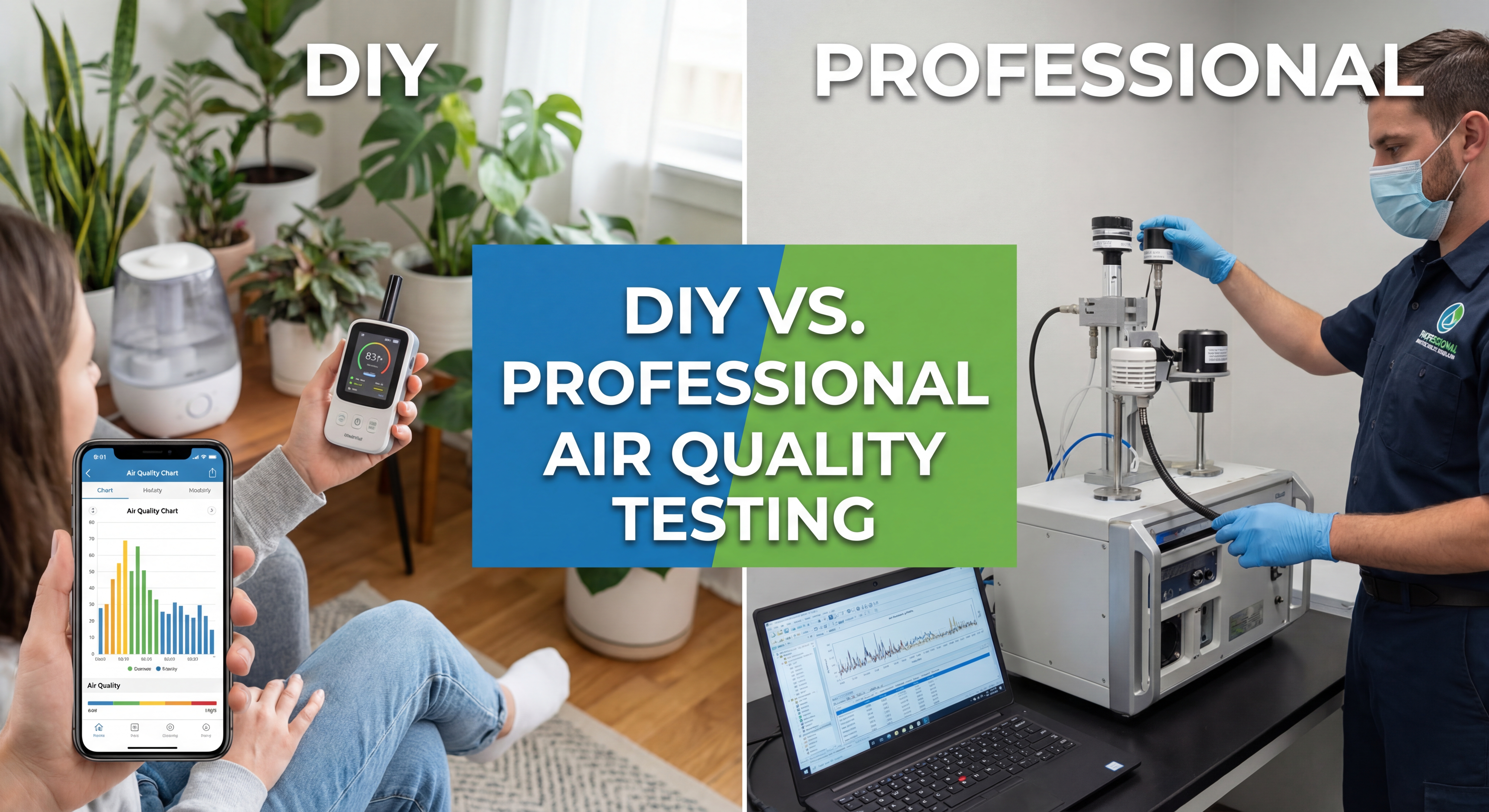
DIY air quality test kits cost less upfront but provide limited accuracy, while professional testing uses calibrated instruments and accredited laboratory analysis to deliver reliable, actionable results. The choice between DIY and professional testing depends on your specific situation, but understanding the differences in accuracy, scope, and reliability is essential before you invest in either option.
Key Takeaway
DIY air quality kits can provide a general indication of certain pollutants, but they lack the accuracy, species identification, and detailed reporting that professional testing provides. For real estate transactions, health investigations, post-remediation verification, and legal documentation, professional testing is the only reliable option.
Home air quality test kits are widely available at hardware stores and online retailers, and their low price point makes them appealing. However, the accuracy and usefulness of DIY results vary significantly depending on what you are testing for. Before choosing between a $30 kit and a professional assessment, it helps to understand exactly what each option can and cannot do.
What Are DIY Air Quality Test Kits?
DIY air quality test kits are consumer products designed to detect specific pollutants in your home. They are available for mold, radon, formaldehyde, lead, VOCs, and general air quality. Most kits fall into two categories:
- Passive collection kits: These include mold settling plates, charcoal radon canisters, and chemical test strips. You expose the collection device to your indoor air for a specified period, then either read the results yourself or mail the sample to a lab for analysis. Lab fees are usually separate from the kit price.
- Electronic monitors: Consumer-grade air quality monitors measure real-time levels of particulate matter, humidity, temperature, and sometimes VOCs or CO2. These devices range from $30 to $200 and provide continuous readings, but their sensors are less precise than professional instruments and degrade over time without calibration.
While these products can raise awareness about potential air quality issues, they have significant limitations that are important to understand before relying on their results for health or financial decisions.
What Does Professional Air Quality Testing Include?
Professional indoor air quality testing is a structured process performed by trained technicians using calibrated, industry-standard equipment. A professional assessment typically includes:
- Initial consultation: A discussion of your concerns, symptoms, building history, and testing goals to determine which specific tests are appropriate.
- Visual inspection: A walkthrough of the property to identify potential sources of contamination, moisture problems, ventilation issues, and areas of concern.
- Calibrated sample collection: Air samples collected using pumps calibrated to precise flow rates, surface samples using standardized methods, and real-time measurements with instruments that are regularly calibrated and maintained.
- Accredited laboratory analysis: All samples are analyzed by laboratories that hold relevant accreditations, ensuring results meet established quality standards.
- Detailed reporting: A comprehensive report that includes specific contaminant identifications, concentrations, comparisons to health guidelines, and actionable recommendations for improvement.
To learn more about what a comprehensive assessment involves, read our guide on what is indoor air quality testing.
How Accurate Are Home Mold Test Kits?
Home mold test kits are among the least reliable DIY testing products available. The most common type is the settling plate, which exposes a petri dish containing growth media to indoor air for a set period. Mold spores that land on the plate grow into visible colonies after several days. The fundamental problem with this method is that mold spores are present everywhere, indoors and outdoors, at all times. A settling plate will almost always grow mold, which leads to false positives that cause unnecessary alarm.
Professional mold testing avoids these pitfalls by using calibrated air sampling pumps that capture a precise volume of air. Both indoor and outdoor samples are collected so that indoor spore counts can be compared to the outdoor baseline. This comparison is essential for determining whether indoor mold levels are actually elevated. Additionally, professional lab analysis identifies mold to the species level, which is important because some species like Stachybotrys and Chaetomium are water-damage indicators with more serious health implications, while others are common outdoor molds that happen to be present indoors at normal levels.
If you are experiencing signs that you may need mold testing, professional assessment provides the definitive, species-level data needed to make informed decisions about your next steps.
Are Home Radon Test Kits Reliable?
Home radon test kits are more reliable than mold kits but still have notable limitations. Short-term charcoal canister kits, the most common DIY option, absorb radon over a two-to-seven-day period and are then mailed to a lab for analysis. When used correctly and under controlled conditions, these kits can provide a reasonable estimate of radon levels.
However, several factors reduce their reliability compared to professional testing. Charcoal canisters are sensitive to humidity, temperature, and air currents, all of which can skew results. They provide only a single average reading for the test period rather than the hourly data points that professional continuous radon monitors (CRMs) record. CRMs also include tamper-evident features and diagnostic data that charcoal kits lack.
The EPA recommends that all homes be tested for radon and that elevated levels of 4 picocuries per liter (pCi/L) or higher be addressed. For real estate transactions, professional radon testing with a CRM is typically required because it provides the documented accuracy, chain of custody, and tamper detection that buyers and lenders expect. Learn more about radon risks in our area in our article on radon levels in North Carolina, South Carolina, and Georgia.
Need reliable air quality results you can trust? Call (864) 619-2092 or schedule a free consultation today.
When Should You Choose Professional Testing?
While DIY kits may be adequate for casual curiosity about your home environment, there are specific situations where professional testing is the clear choice:
- Real estate transactions: Buyers, sellers, and lenders typically require professional test results with proper documentation for radon, mold, asbestos, and lead. DIY results are generally not accepted for real estate closings.
- Health symptoms: If you or your family members are experiencing unexplained respiratory issues, headaches, allergies, or other symptoms that improve when you leave the building, professional testing can identify the specific pollutants responsible and their concentrations.
- Post-remediation verification: After mold remediation, asbestos abatement, or lead paint removal, professional clearance testing is essential to confirm that the work was completed successfully and that contaminant levels are within safe limits.
- Legal or insurance documentation: If you need air quality data for a legal matter, insurance claim, or landlord-tenant dispute, only professional results from accredited laboratories carry the weight needed for these purposes.
- Commercial buildings: Workplace IAQ complaints, OSHA compliance, and building commissioning all require professional-grade testing with documented methods and calibrated instruments.
Cost Comparison: DIY vs Professional
At first glance, DIY testing appears significantly cheaper. A home mold test kit costs $10 to $40 plus $30 to $75 in lab fees, while professional mold testing runs $250 to $600. A charcoal radon kit costs $15 to $30 plus lab fees, compared to $150 to $300 for professional radon testing. Consumer air quality monitors range from $30 to $200, while a comprehensive professional IAQ assessment costs $300 to $600.
However, the true cost comparison must account for accuracy and outcomes. A false positive from a DIY mold kit could lead you to spend thousands on unnecessary remediation. A false negative could leave a real problem unaddressed, leading to worsening health effects and more extensive damage over time. Professional testing provides the accuracy needed to avoid both scenarios, making it a better value when the stakes are meaningful.
For a more detailed breakdown of professional testing costs, see our guide on how much air quality testing costs.
Get accurate results the first time. Contact A1 Air Quality Consultants or call (864) 619-2092 for a free consultation.