
October 15, 2025 · By A1 Air Quality Consultants
Last updated: March 4, 2026
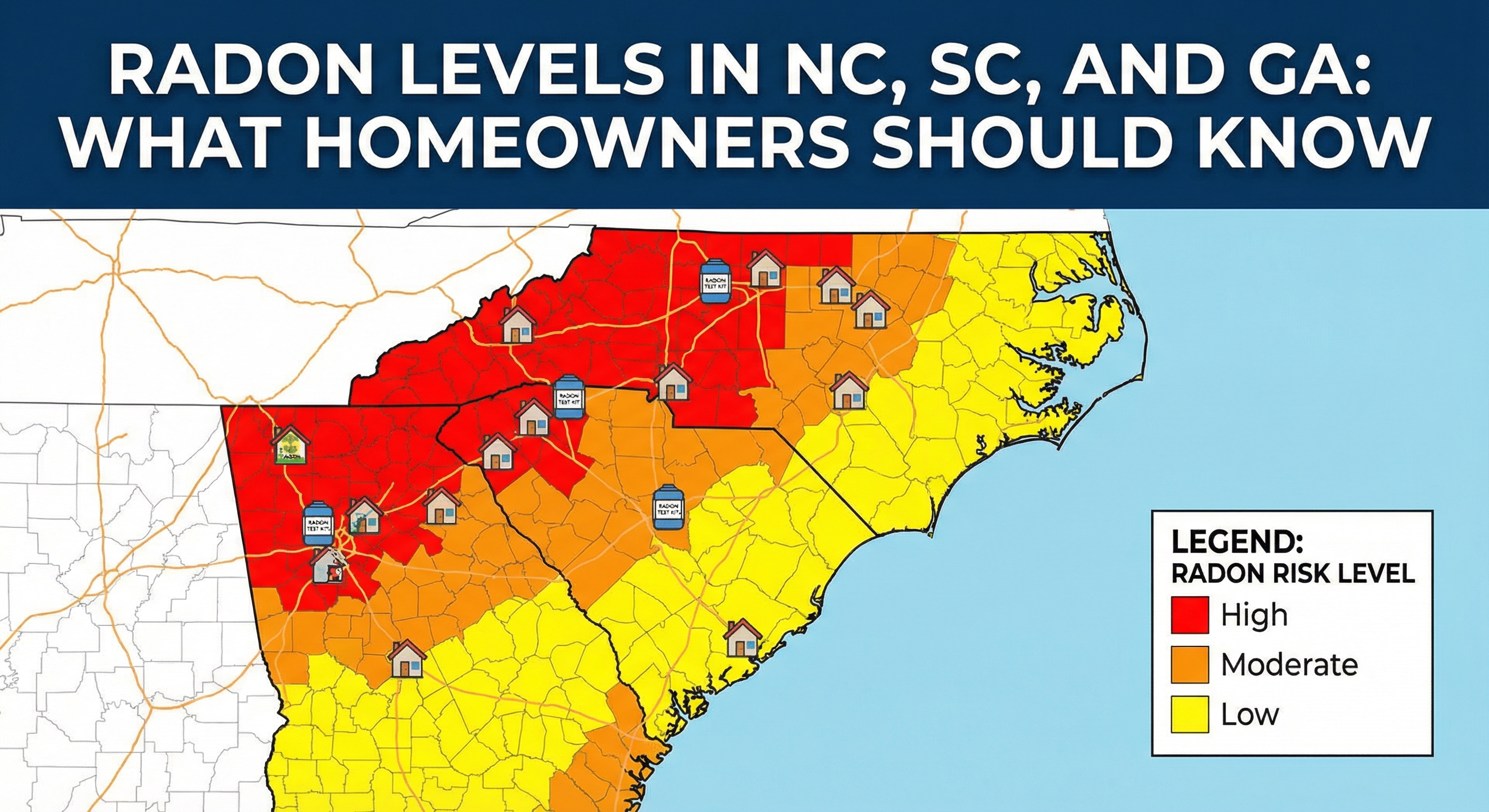
Radon is a naturally occurring radioactive gas that poses a serious health risk to homeowners across North Carolina, South Carolina, and Georgia, with risk levels that vary significantly by geography. As the second leading cause of lung cancer in the United States — responsible for approximately 21,000 deaths annually according to the EPA — radon is a regional concern. The western mountains of North Carolina, the Piedmont Upstate of South Carolina, and the northern Georgia highlands all contain areas with elevated radon potential, but dangerously high levels have been found in homes across all three states regardless of zone designation. Testing is the only way to know whether your home is safe.
Key Takeaway
Radon levels vary significantly across North Carolina, South Carolina, and Georgia, with mountain and piedmont regions generally showing higher concentrations. The EPA recommends testing every home regardless of location, and mitigation is recommended for levels at or above 4 pCi/L.
What Is Radon and Where Does It Come From?
Radon is a colorless, odorless, tasteless radioactive gas produced by the natural decay of uranium in soil, rock, and groundwater. It exists everywhere in outdoor air at very low levels, typically around 0.4 picocuries per liter (pCi/L). The problem arises when radon seeps into enclosed structures like homes and accumulates to dangerous concentrations.
Radon enters homes through multiple pathways:
- Cracks in foundation slabs and basement floors
- Gaps around pipes, cables, and utility penetrations
- Construction joints where walls meet floors
- Hollow-block concrete walls
- Exposed soil in crawl spaces
- Well water (radon dissolved in groundwater can be released when water is used for showering or cooking)
The concentration of radon in any given home depends on the uranium content of the underlying soil and rock, the permeability of the ground, the construction type and condition of the foundation, and the home's ventilation. Two homes on the same street can have dramatically different radon levels, which is why individual home testing is essential rather than relying on neighborhood or zone data alone.
What Are the EPA Radon Zones for NC, SC, and GA?
The EPA classifies every county in the United States into one of three radon zones based on predicted average indoor radon levels. Understanding your zone helps assess risk, but it does not replace testing.
Zone 1 (Highest Potential): Predicted average indoor levels above 4 pCi/L. The EPA recommends all homes in Zone 1 be tested.
Zone 2 (Moderate Potential): Predicted average indoor levels between 2 and 4 pCi/L.
Zone 3 (Lower Potential): Predicted average indoor levels below 2 pCi/L.
Is Radon a Problem in North Carolina?
North Carolina has significant radon risk, particularly in the western mountain region. Zone 1 counties with the highest predicted radon levels include Buncombe (Asheville), Henderson, Transylvania, Haywood, Madison, Mitchell, Avery, Watauga, and Caldwell counties. The Piedmont region, including Mecklenburg (Charlotte), Wake (Raleigh), Guilford (Greensboro), and Forsyth (Winston-Salem) counties, falls primarily in Zone 2 with moderate risk. The Coastal Plain region generally falls in Zone 3 but still contains homes with elevated levels.
According to the North Carolina Radon Program, approximately one in four homes tested in the western part of the state has radon levels at or above the EPA action level of 4 pCi/L. Even in the Piedmont and Coastal regions, individual homes routinely test above the action level.
Is Radon a Problem in South Carolina?
South Carolina's radon risk is concentrated in the Upstate and Piedmont regions. Counties with the highest radon potential include Oconee, Pickens, Greenville, Spartanburg, Anderson, Cherokee, and York counties — all in Zone 2 with moderate to elevated risk. The Midlands and Lowcountry regions, including Charleston, Columbia, and the coastal areas, generally fall in Zone 3.
However, SCDES (the South Carolina Department of Environmental Services) has documented homes with radon levels exceeding 4 pCi/L in all regions of the state. The granitic geology of the Upstate produces naturally higher uranium concentrations, but sandy soils in the Coastal Plain can also allow radon to migrate easily into homes.
Is Radon a Problem in Georgia?
Georgia's radon risk follows a similar geographic pattern. The northern mountain and Piedmont counties have the highest radon potential. Zone 1 counties include Cobb, DeKalb, Fulton (Atlanta), Gwinnett, Hall, Lumpkin, White, Dawson, and Gilmer counties. Much of the northern half of the state falls in Zone 2. The Coastal Plain and southern Georgia counties generally fall in Zone 3, with lower but not zero risk.
The Georgia Department of Natural Resources reports that approximately 14% of homes tested statewide have radon levels at or above 4 pCi/L, with significantly higher percentages in the northern counties.
What Are the Health Risks of Radon Exposure?
Radon is the second leading cause of lung cancer in the United States, behind only cigarette smoking. The EPA estimates that radon causes approximately 21,000 lung cancer deaths each year. For non-smokers, radon is the leading cause of lung cancer.
When radon gas is inhaled, its radioactive decay products (polonium-218 and polonium-214) lodge in the lining of the lungs and emit alpha radiation. This radiation damages lung tissue DNA over time, potentially leading to cancer. The risk increases with both the concentration of radon and the duration of exposure.
Key health statistics from the EPA and CDC:
- Radon causes more deaths than drunk driving, house fires, and drowning combined
- A person living in a home with radon at 4 pCi/L has approximately a 1-in-50 lifetime risk of developing lung cancer (for non-smokers) and approximately a 1-in-7 risk (for smokers)
- The risk is cumulative — longer exposure at lower levels can be as dangerous as shorter exposure at higher levels
- There is no safe level of radon. Even levels below the 4 pCi/L action level carry some risk, which is why the EPA also recommends considering mitigation at levels between 2 and 4 pCi/L
- Children may be at greater risk due to their higher respiratory rates and developing lung tissue
Understanding radon's health effects is critical for making informed decisions about testing and mitigation. Our comprehensive guide on understanding radon as a silent health risk covers the science behind radon exposure in greater depth.
Want to know your home's radon level? Call (864) 619-2092 or schedule a free consultation today.
Is Radon Testing Required for Real Estate Transactions?
None of the three states — North Carolina, South Carolina, or Georgia — currently require radon testing as part of residential real estate transactions. However, the EPA strongly recommends testing before buying or selling any home, and the practice has become increasingly standard.
For homebuyers in the region, here is what you should know:
- Buyer's right to test: Buyers can request radon testing as part of the inspection contingency period. This is common practice and most sellers agree to allow testing.
- Professional testing preferred: For real estate transactions, professional testing with continuous radon monitors (CRMs) is preferred over DIY kits. CRMs provide hour-by-hour data, tamper indicators, and results that are more defensible in negotiations.
- Negotiation tool: If testing reveals elevated radon levels, buyers can negotiate with sellers for mitigation to be completed before closing or for a price reduction to cover mitigation costs. Professional radon mitigation systems typically cost between $800 and $2,500.
- Disclosure: While not federally mandated for radon the way lead paint is, some states require disclosure of known radon test results. Sellers who have previously tested and found elevated levels should disclose this information.
If you are buying a home, radon testing should be part of your comprehensive home inspection checklist covering mold, asbestos, lead, and radon. Our article on radon testing before buying a home provides detailed guidance on the process.
How Is Radon Testing Performed?
Professional radon testing is straightforward and non-invasive. There are two main categories of testing:
Short-term testing (2-7 days): This is the most common approach, especially for real estate transactions. A continuous radon monitor (CRM) is placed in the lowest livable level of the home, typically the basement or ground floor. The home is maintained under closed-building conditions (windows and exterior doors closed, except for normal entry and exit) for at least 12 hours before and during the entire test period. Professional CRMs record radon levels every hour and calculate an average, providing detailed data about radon fluctuations.
Long-term testing (90+ days): Long-term tests use devices like alpha-track detectors or electret ion chambers that remain in the home for 90 days or more. These tests provide a more accurate picture of the home's average radon level across seasonal variations, as radon levels naturally fluctuate with weather, soil conditions, and home ventilation patterns. Long-term tests are ideal for homeowners who want the most accurate baseline measurement.
Professional testing offers significant advantages over DIY kits. Certified radon measurement professionals use calibrated equipment, follow standardized protocols, and provide results that are recognized by lenders, insurers, and regulatory agencies. Professional continuous monitors also include tamper indicators and environmental sensors that document test conditions.
Comprehensive indoor air quality testing can be performed alongside radon testing to evaluate other air quality parameters including mold spores, volatile organic compounds, and particulate matter.
What Happens If Your Home Has High Radon Levels?
If testing reveals radon levels at or above 4 pCi/L — or even between 2 and 4 pCi/L — mitigation is recommended. The good news is that radon mitigation is effective and relatively straightforward.
The most common mitigation approach is sub-slab depressurization (SSD), also called active soil depressurization (ASD). This system involves:
- Installing a PVC pipe through the foundation slab or crawl space membrane into the soil below
- Connecting the pipe to a continuously running fan that draws radon from beneath the foundation
- Venting the radon-laden air above the roofline where it disperses harmlessly into the atmosphere
- Sealing major cracks and openings in the foundation to improve system efficiency
Professionally installed mitigation systems can reduce radon levels by up to 99%. Most systems lower indoor radon to well below 2 pCi/L. The systems are quiet, energy-efficient (operating costs are roughly comparable to a light bulb), and require minimal maintenance beyond periodic fan replacement every 5 to 10 years.
For homes with crawl spaces, crawl space encapsulation combined with sub-membrane depressurization provides effective radon reduction. For homes on well water with radon in the water supply, aeration or granular activated carbon treatment systems can address waterborne radon.
Post-mitigation testing is essential to verify that the system is performing as intended and that radon levels have been reduced to acceptable levels. Ongoing monitoring every two years is recommended by the EPA to ensure the system continues working properly.
Need professional testing? Contact A1 Air Quality Consultants or call (864) 619-2092 for a free consultation.