December 10, 2025 · By A1 Air Quality Consultants
Last updated: March 4, 2026
Yes, radon testing is strongly recommended before buying any home. The EPA recommends testing all homes below the third floor regardless of geographic location, age, or construction type, because radon is the second leading cause of lung cancer in the United States, responsible for approximately 21,000 deaths each year. Radon is an invisible, odorless, radioactive gas that can accumulate to dangerous levels in any home, and the only way to know if a home has elevated radon is to test it.
Key Takeaway
Yes — the EPA strongly recommends radon testing before purchasing any home, regardless of location or age. Radon is the second leading cause of lung cancer, and elevated levels can be found in any type of home in any state.
Why Is Radon Testing Important Before Buying a Home?
Radon is a naturally occurring radioactive gas produced by the decay of uranium in soil and rock beneath your home. It enters through cracks in foundations, gaps around pipes, sump pump openings, and any other point of contact between the home and the ground. Once inside, radon can accumulate to concentrations that significantly increase your risk of developing lung cancer.
According to the EPA, radon is responsible for about 21,000 lung cancer deaths per year in the United States. The Surgeon General has warned that radon is the second leading cause of lung cancer after cigarette smoking. For non-smokers, radon is the number one cause of lung cancer. These statistics make radon testing one of the most important health-related steps you can take when purchasing a home.
Unlike other home defects that a general inspector might identify — a leaky roof, faulty wiring, or foundation cracks — radon is completely invisible and has no smell or taste. You cannot see it, feel it, or detect it with your senses. A home with dangerously high radon levels looks and feels exactly like a home with low levels. Only testing can tell you the difference. For a deeper understanding of this hazard, read our guide on understanding radon as a silent health risk.
What Radon Levels Are Considered Dangerous?
The EPA has established an action level of 4 picocuries per liter (4 pCi/L) for indoor radon. At or above this level, the EPA strongly recommends that homeowners take steps to reduce radon concentrations, typically by installing a radon mitigation system.
However, the EPA also emphasizes that there is no known safe level of radon exposure. Even levels below 4 pCi/L carry some risk. The agency recommends that homeowners consider mitigation for radon levels between 2 and 4 pCi/L as well. The average indoor radon level in the United States is approximately 1.3 pCi/L, and the average outdoor level is about 0.4 pCi/L.
To put this in perspective, the EPA estimates that living in a home with radon levels of 4 pCi/L carries a lung cancer risk comparable to smoking half a pack of cigarettes per day. For a family of four spending 70% of their time at home, radon at 4 pCi/L results in an estimated lung cancer risk of about 7 in 1,000 for non-smokers — and significantly higher for smokers.
Radon levels vary significantly by region. For area-specific information about the Carolinas and Georgia, see our article on radon levels in North Carolina, South Carolina, and Georgia.
How Does Radon Testing Work During a Real Estate Transaction?
Radon testing during a home purchase follows a specific process designed to provide accurate, reliable results within the typical inspection timeline.
Step 1: Schedule the test during your inspection period. Radon testing should be scheduled at the same time as your general home inspection. Most purchase contracts include a due diligence or inspection period during which the buyer can conduct any inspections they choose.
Step 2: Closed-building conditions. For accurate results, the home must maintain closed-building conditions for at least 12 hours before and during the entire test. This means keeping windows and exterior doors closed (normal entry and exit is fine) and not operating fans or air-handling systems that bring in outside air. The seller or their agent should be notified of these requirements in advance.
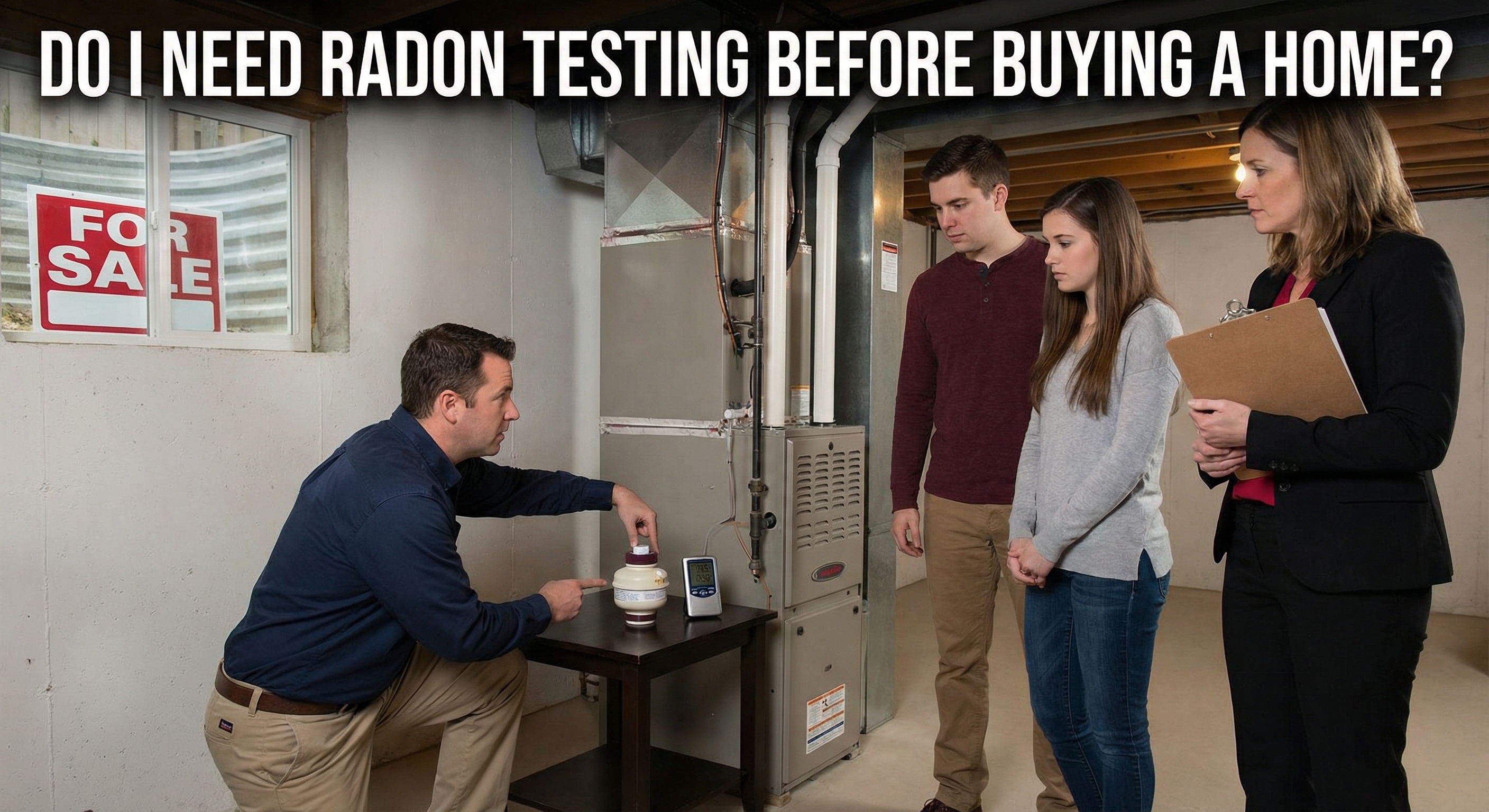
Step 3: Monitor placement. A certified radon testing professional places a continuous radon monitor (CRM) in the lowest livable area of the home — typically a finished basement or the ground floor if there is no basement. The monitor records radon levels every hour for a minimum of 48 hours.
Step 4: Results and reporting. After the test period, the inspector retrieves the monitor and generates a detailed report showing hourly readings, the average radon concentration, and whether the home is above or below the EPA action level. Results are typically available immediately after the monitor is retrieved.
Step 5: Tamper detection. Professional continuous radon monitors include motion sensors and other tamper-detection features. If the monitor is moved or conditions are compromised during the test, this is documented in the report. This is one of the key advantages of professional testing over DIY test kits.
Buying a home? Get radon testing before you close. Call (864) 619-2092 or schedule a free consultation today.
Who Pays for Radon Testing When Buying a Home?
In most real estate transactions, the buyer pays for radon testing as part of their due diligence. Radon testing typically costs between $150 and $300 when performed by a certified professional, which is a relatively small investment compared to the value of the home and the potential health risks involved.
Some situations where the payment structure may differ include:
- Seller-initiated testing: Some sellers proactively test for radon before listing to remove potential obstacles. While this is helpful, buyers should consider whether the test is recent and was conducted by an independent, certified professional.
- Agent recommendations: In some markets, real estate agents may recommend that sellers include radon testing in their pre-listing preparations.
- New construction: Builders in some areas are required to install passive radon-resistant features. However, testing after construction is still recommended because passive systems do not always reduce radon to safe levels.
What Happens If Radon Levels Are High?
Discovering elevated radon levels during a home purchase does not have to be a deal-breaker. Radon mitigation is well-established, highly effective, and relatively affordable. Here is how the process typically unfolds.
Negotiating with the seller: If radon levels are at or above 4 pCi/L, buyers typically have several options:
- Request that the seller install a radon mitigation system before closing
- Negotiate a credit toward the purchase price to cover the cost of mitigation
- Request that the seller contribute to the cost of a mitigation system
- In rare cases, use the results as grounds to renegotiate the purchase price or withdraw from the contract
Mitigation system costs: A professionally installed radon mitigation system typically costs between $800 and $2,500, depending on the home's foundation type, size, and the complexity of the installation. These systems use a fan and PVC piping to draw radon from beneath the foundation and vent it safely above the roofline.
Mitigation effectiveness: Active soil depressurization systems — the most common type — are highly effective, typically reducing radon levels by 80% to 99%. A post-mitigation test is always recommended to verify that the system has brought levels below 4 pCi/L, and ideally below 2 pCi/L.
Are There State Requirements for Radon Testing in Real Estate?
Radon disclosure and testing requirements vary by state. In the Southeast, where A1 Air Quality Consultants operates, the regulations include:
South Carolina: South Carolina does not require radon testing for real estate transactions, but the state does require sellers to disclose any known radon hazards on the property disclosure form. Professional radon testers and mitigators should follow EPA and AARST (American Association of Radon Scientists and Technologists) protocols.
North Carolina: North Carolina requires sellers to disclose known radon issues on the residential property disclosure statement. While testing is not mandated by state law, the North Carolina Radon Program strongly recommends testing during real estate transactions, especially in western North Carolina counties where radon levels tend to be higher.
Georgia: Georgia does not have specific radon disclosure requirements or mandatory testing laws for real estate. However, the Georgia Department of Natural Resources recommends that all homes be tested for radon, and many lenders and home inspectors in the state encourage testing.
Regardless of state requirements, radon testing before a home purchase is considered a best practice by the EPA, the National Association of Realtors, and virtually every public health organization. The small cost of testing is far outweighed by the peace of mind and protection it provides.
Can I Rely on a DIY Radon Test Kit When Buying a Home?
While DIY radon test kits are available at hardware stores for as little as $15 to $30, they are generally not recommended for real estate transactions for several important reasons:
- No tamper detection: DIY kits cannot detect whether testing conditions were compromised, which is critical when another party has access to the property
- Less accurate: Charcoal canister kits are less precise than professional continuous radon monitors
- Delayed results: DIY kits must be mailed to a laboratory, adding 1 to 2 weeks for results — a significant delay during a time-sensitive transaction
- No hourly data: A professional CRM provides hour-by-hour readings, which can identify unusual fluctuations or potential tampering
- Legal and negotiation limitations: Results from professional, certified testers carry more weight in negotiations and legal proceedings
For the most reliable results during a home purchase, always use a certified radon testing professional with calibrated continuous radon monitors. Independent testing companies like A1 Air Quality Consultants, with over 25 years of experience in environmental testing, ensure your results are accurate and unbiased. For a complete overview of what to test for when buying a home, see our home inspection checklist for mold, asbestos, lead, and radon.
What Should Home Buyers Know About Radon and Air Quality?
Radon is just one component of overall indoor air quality, but it is among the most dangerous because of its direct link to lung cancer and the fact that it is entirely undetectable without testing. Home buyers should understand several key points:
- Radon levels can vary dramatically between neighboring homes — even homes with identical construction
- New homes are not immune to radon — modern tight construction can actually concentrate radon indoors
- A home with a radon mitigation system is not a negative — it means the problem has been identified and solved
- Radon testing should be repeated every two years or after significant structural changes
- The cost of testing and mitigation is minimal compared to the health risks of long-term exposure
The EPA estimates that the national cost of radon-related lung cancer exceeds $2 billion per year in direct and indirect healthcare costs. A $150 to $300 radon test before closing on your new home is one of the simplest, most cost-effective health protection measures available to home buyers.
Need professional testing? Contact A1 Air Quality Consultants or call (864) 619-2092 for a free consultation.